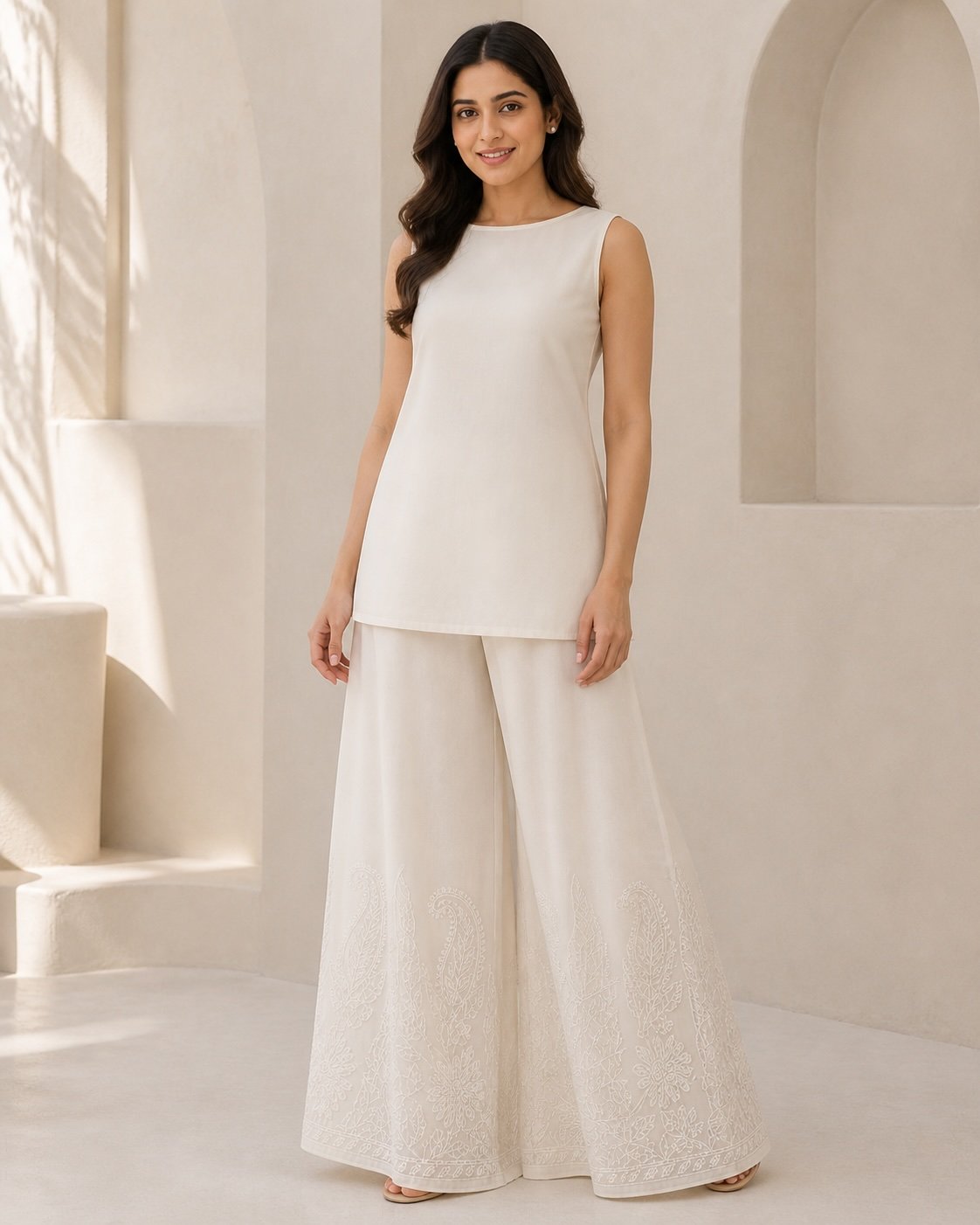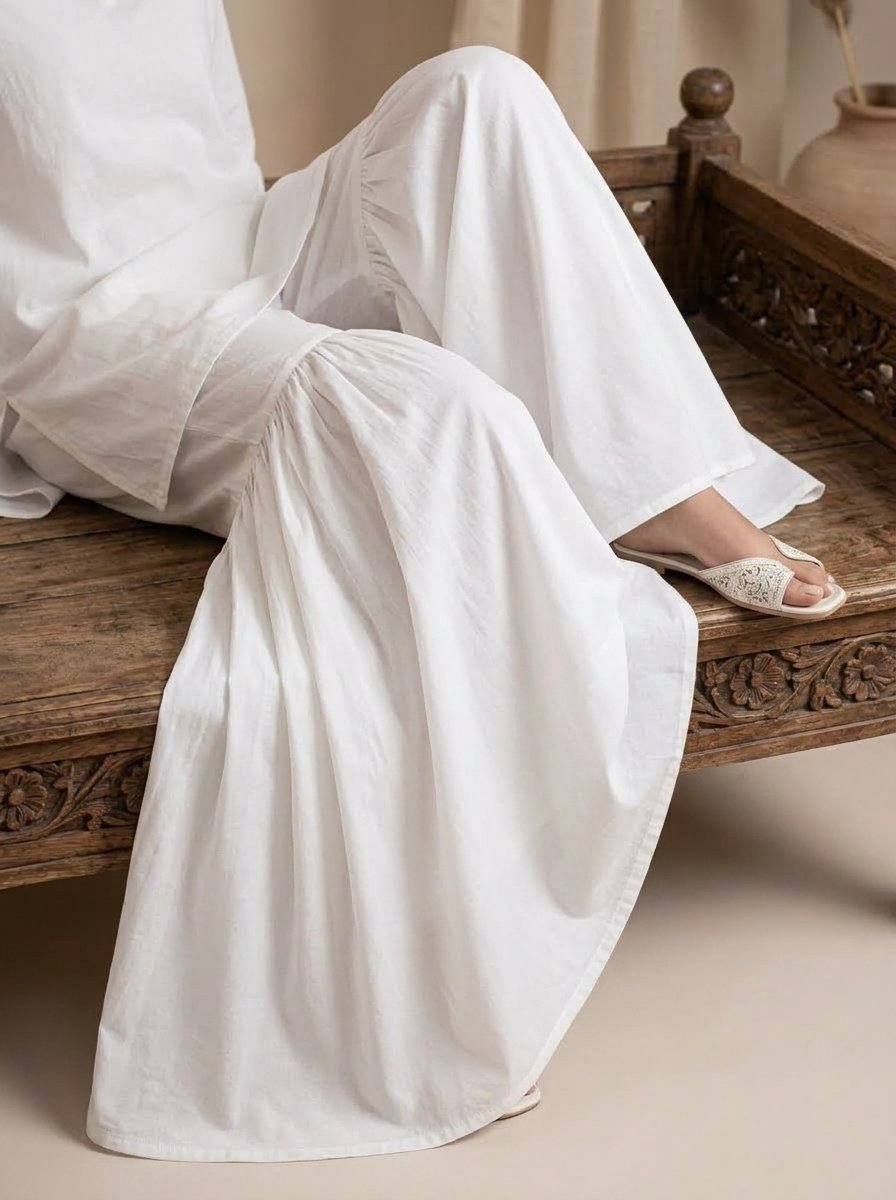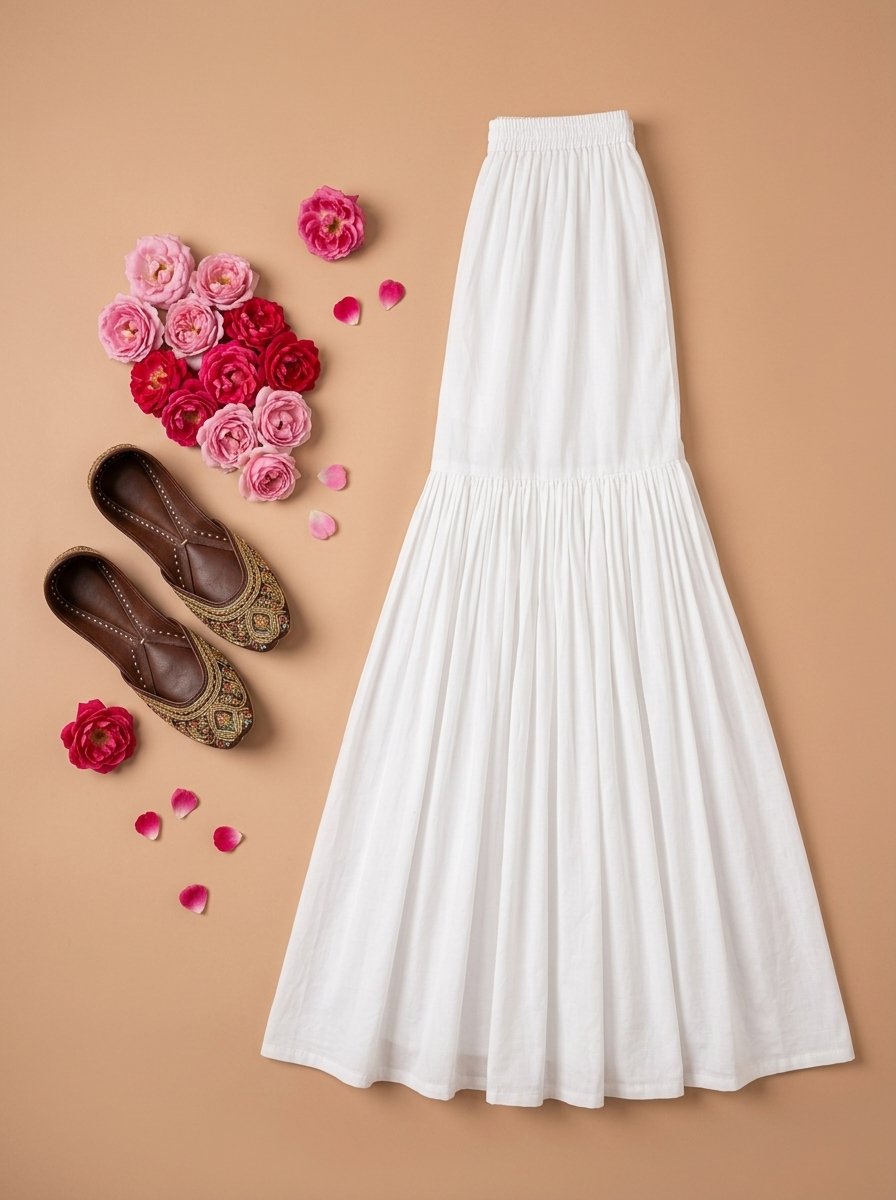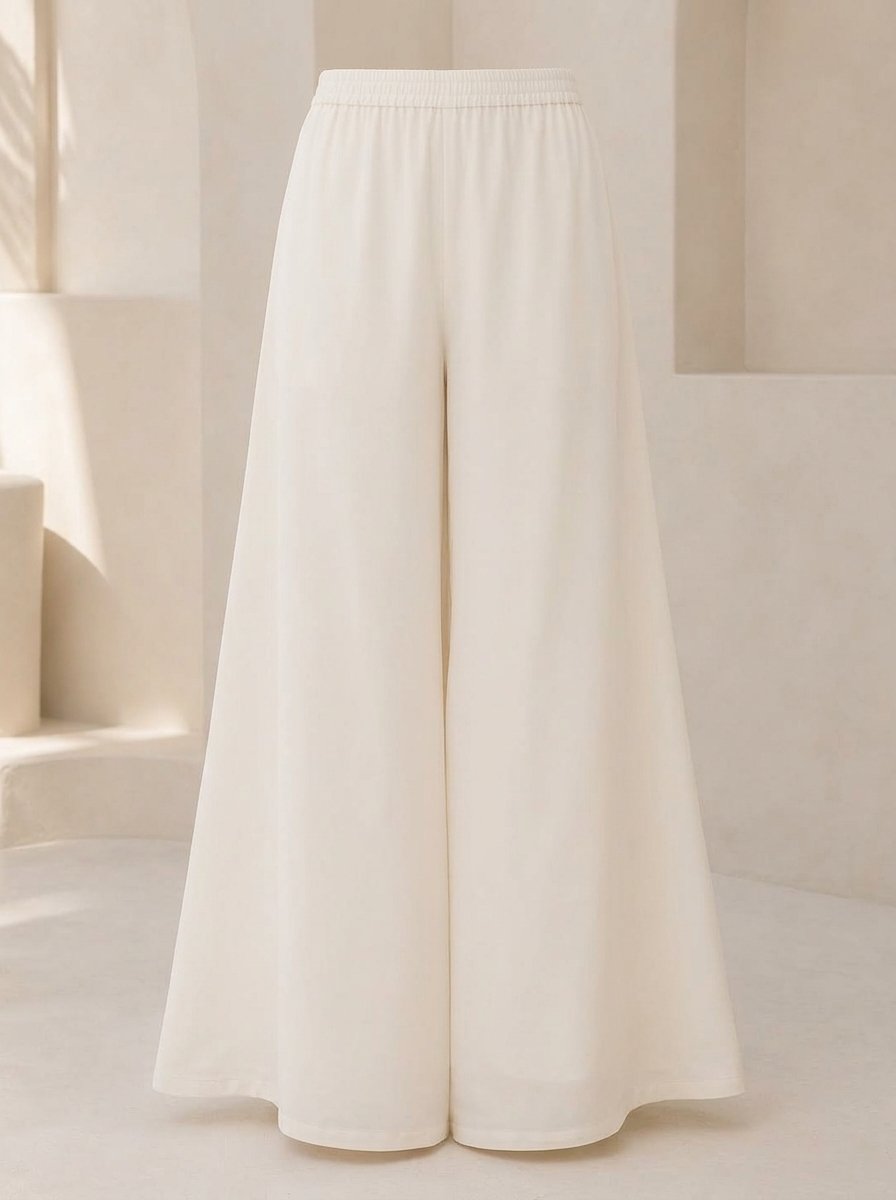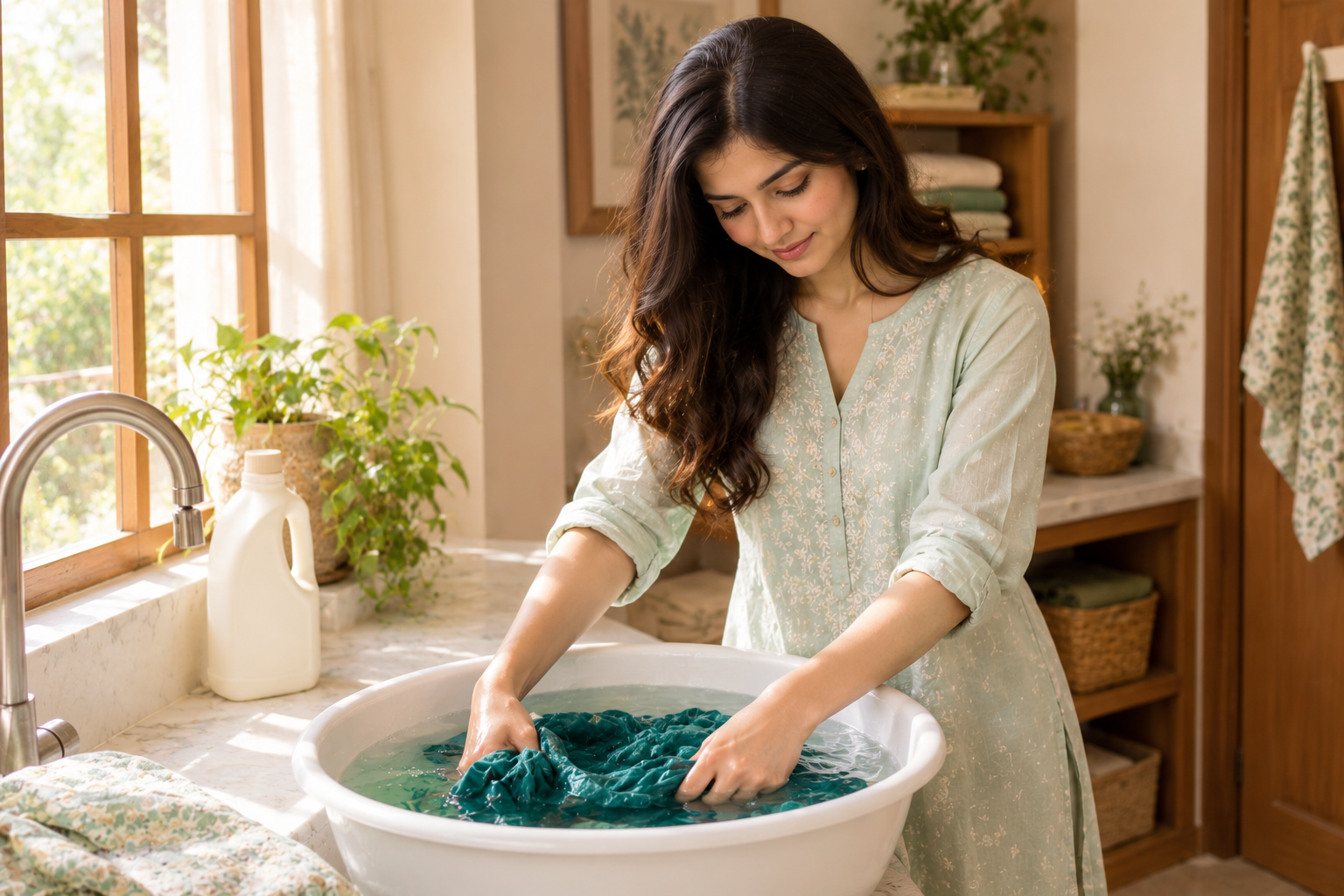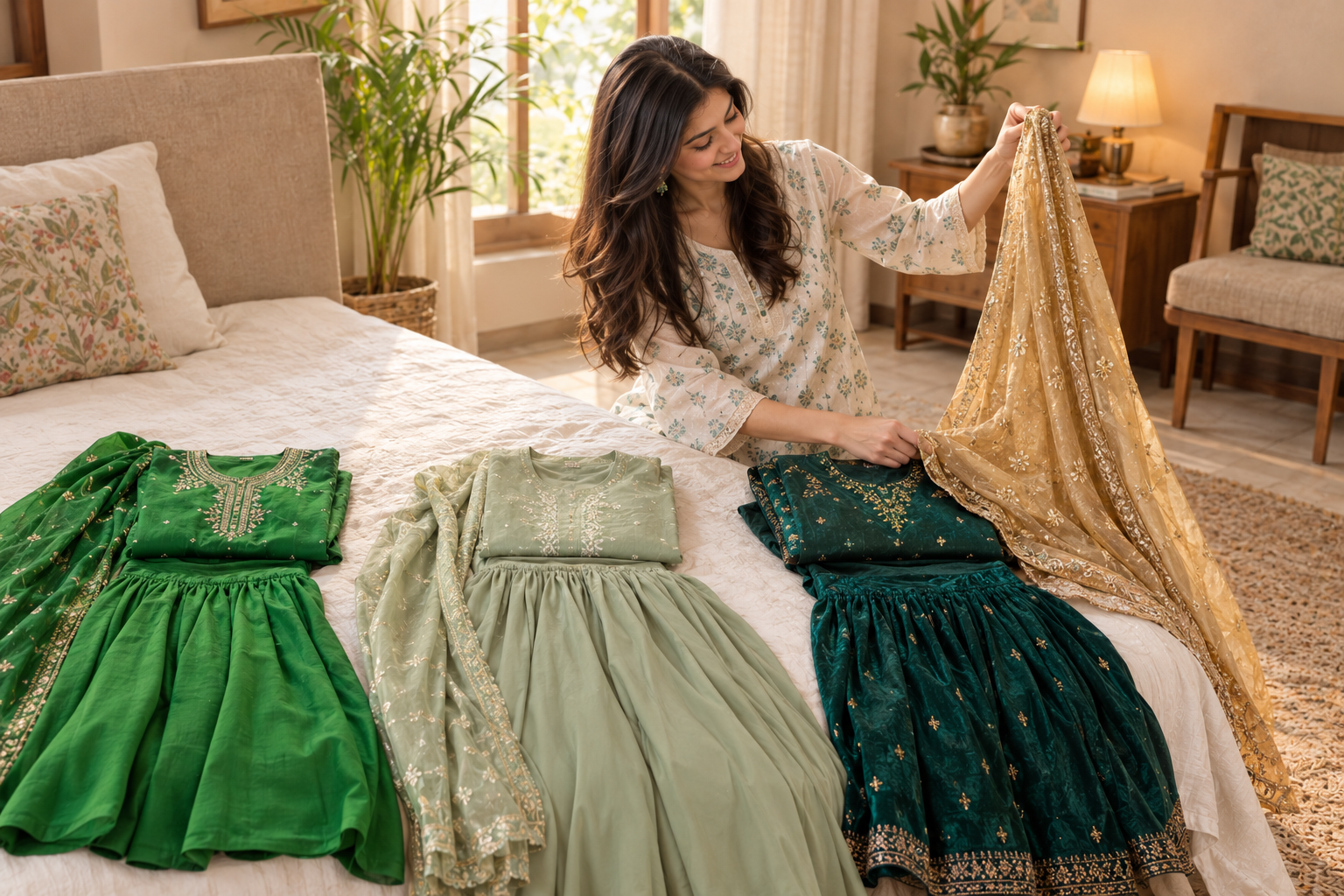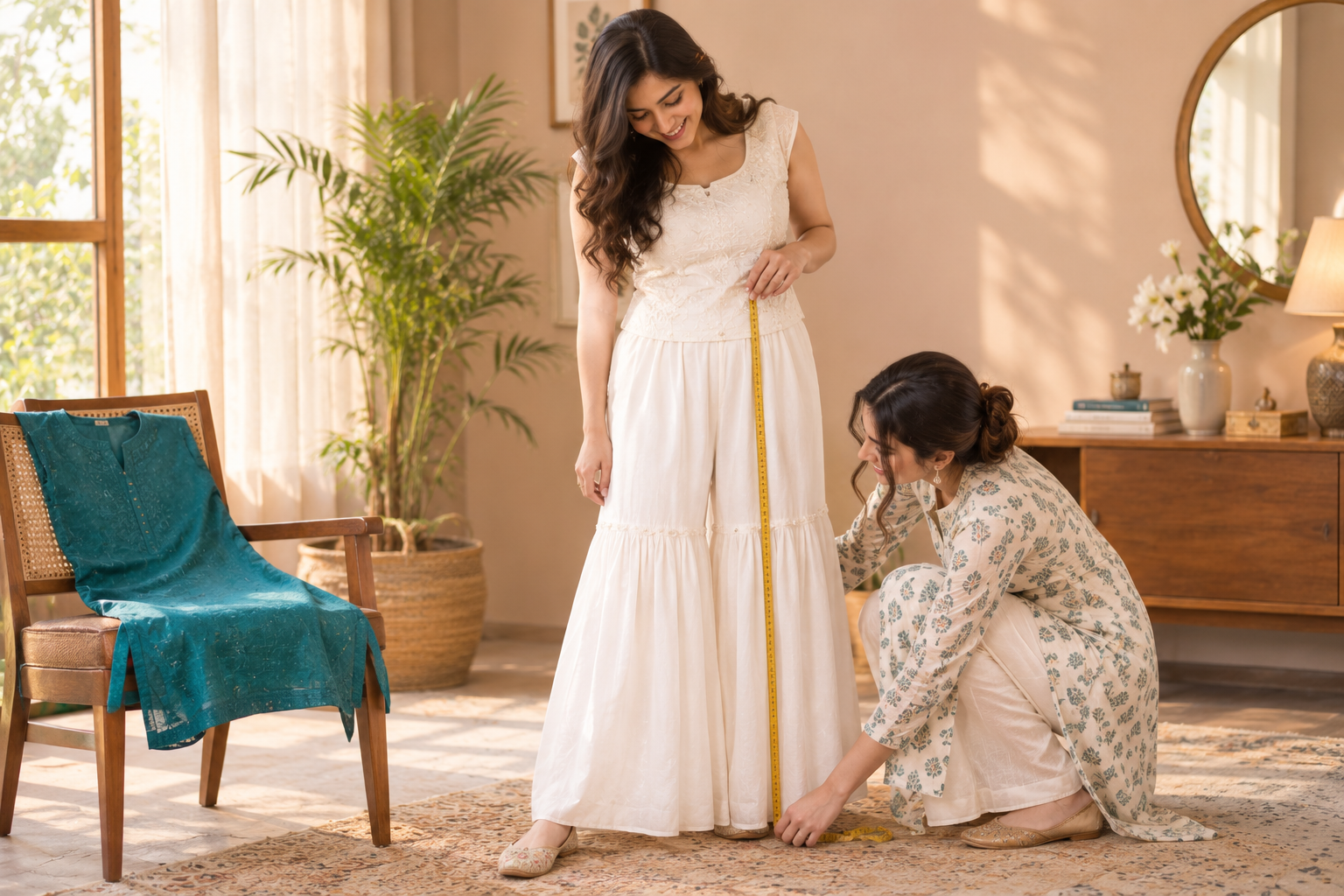
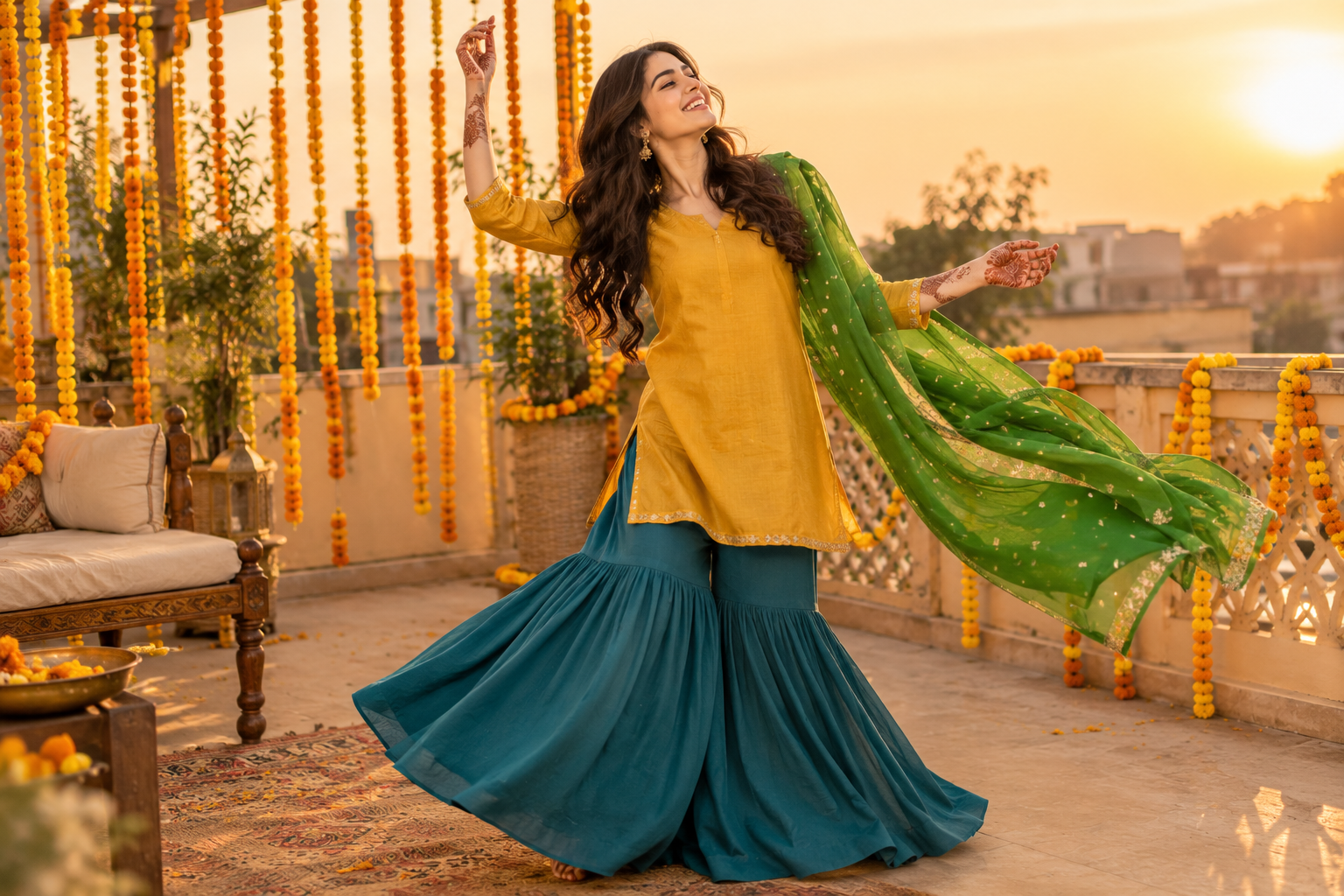
Girl dancing in a teal sharara with henna on her hands, a mehndi dress for girls

Mehndi Dresses for Girls: 8 Sharara and Gharara Looks (With the Colors to Wear)

Mehndi dresses for girls have one job before they look good: let you sit on the floor, dance all night and still enjoy the evening.

The 2026 guides agree on the shape. RJ’s Pret calls the sharara set 2026’s defining mehndi silhouette, and says it is far more comfortable for sitting cross-legged, dancing and applying henna. So we built this guide around the sharara and the gharara. We also add a twist most guides skip. A plain white sharara is not a mehndi dress yet. It becomes one when you dye it.

What Makes a Mehndi Dress Work?

Think comfort, colour and courtesy, in that order.

  • Comfort. Rangreza’s 2026 mehndi guide recommends sharara and gharara sets for bridesmaids and guests who want to stay active. It says light fabrics suit daytime mehndi functions.
  • Light work. Vanya’s bridesmaid guide notes that bridesmaids often prefer lighter work, and that mirror work and gota dominate mehndi outfits.
  • Colour. The next section covers it.
  • Courtesy. Dress for the event, and do not upstage the bride.

Which Colours Suit Mehndi Dresses for Girls?

Mehndi is the colourful function, so bright shades are welcome.

  • Bright and festive: yellow, green, orange, coral, fuchsia, teal and multicolour combinations, according to RJ’s Pret.
  • Soft for bridesmaids: peach, mint and lavender, according to Rangreza.
  • Courtesy: if you know the bride’s colour, RJ’s Pret says it is courteous to choose a slightly different shade.

Some colours need care. Faisal Silk says black and pure white are usually avoided for mehndi in most Pakistani traditions. RJ’s Pret adds that guests should avoid white, which is associated with mourning, and red, which is reserved for the bride at the baraat. Libayah notes that none of these is an absolute ban everywhere, so ask the family if you are unsure.

Why Should You Dye a White Sharara Before a Mehndi?

Because white is the colour most guides tell guests to avoid at a mehndi. So a white sharara is a base, not a finished outfit. That is exactly why ours arrive white and dyeable: you choose the festive shade.

Take your kurti and the white sharara to a dyer, ask for a swatch test, and check it in daylight. Dyeing usually costs around Rs. 300, and wide pieces may be priced differently, so ask first. At the listed price, the White Sharara Pants cost Rs. 2,500, so a dyed pair comes to around Rs. 2,800. Check the product page for the current price.

Results depend on the dyer, so we never promise an exact shade. For the steps, read How to Dye a White Shalwar to Match Your Shirt and How Much Does It Cost to Dye a Shalwar in Pakistan?.

[INSERT: a real customer’s mehndi look, with the shade she dyed to and what her dyer quoted, with permission.]

Eight Mehndi Dresses for Girls to Try

In every look, “dye” means starting from a white sharara or gharara.

Look 1: Marigold and deep green (Contrast)

Wear a marigold kurti with a sharara dyed deep green. Add an ivory dupatta and embellished juttis. The green grounds the bright kurti.

Look 2: Fuchsia and lime (Contrast)

Pair a fuchsia kurti with a sharara dyed lime green. Choose a yellow dupatta with gota. This is a loud, joyful green mehndi dress.

Look 3: Coral and teal (Contrast)

Wear a coral kurti with a sharara dyed teal. Add a light gold dupatta. Teal is a bold shade that suits mehndi.

Look 4: Yellow and mint (Contrast)

Wear a sunshine yellow kurti with a gharara dyed pale mint. Add a mint organza dupatta for a soft, modern yellow mehndi dress.

Look 5: Teal on teal (Match)

Dye the sharara to match a teal kurti. Add a dupatta with mirror work or gota, so the sparkle carries the outfit.

Look 6: Peach and lavender (Soft)

Pair a peach kurti with a sharara dyed lavender. It is a gentle, simple mehndi dress that suits a daytime function.

Look 7: A busy print, one calm bottom

Take a multicolour kurti, and dye the sharara to the print’s quietest colour. RJ’s Pret says multicolour and neutral combinations work for guests.

Look 8: Coordinated sisters

Buy the same white sharara for three sisters, and dye them mint, peach and lavender with matching kurtis. Waqas Shah’s wedding guide lists coordinated sisters for mehndi.

How Do You Avoid Clashing With the Bride and Family?

Send three messages, and you avoid most awkward photos.

  1. Ask the bride’s sister or a cousin for the colour theme.
  2. Tell your own sisters or friends your shade.
  3. Confirm that your shade is slightly different from the bride’s.

The Waqas Shah guide gives the rule in one line: match the event, not the bride.

Does Your Mehndi Dress Pass the Sit-and-Dance Test?

Mehndi means sitting on the floor and dancing, so test before you commit. Run the dance test from our sharara outfit ideas guide. Then add one more check: sit cross-legged on the floor and stand up without help.

Choose footwear you can dance in. Embellished juttis, flats and khussa all work.

When Should You Dye for a Mehndi?

Work backwards from the event date.

  1. Choose your shade, and check it against the bride’s colour if you know it.
  2. Take the white sharara and your kurti to the dyer.
  3. Ask for a swatch test and a pickup date. Busy wedding weeks may change the date, so leave a buffer.
  4. Check the dry swatch in daylight and in warm light. Our guide Why Your Shalwar Never Matches Your Kameez (and the Fix) explains why.
  5. Wash the dyed piece separately for the first few washes, as in Wash Dyed Bottoms Without Fading.

Shop the Look: Start With a White Base for Mehndi

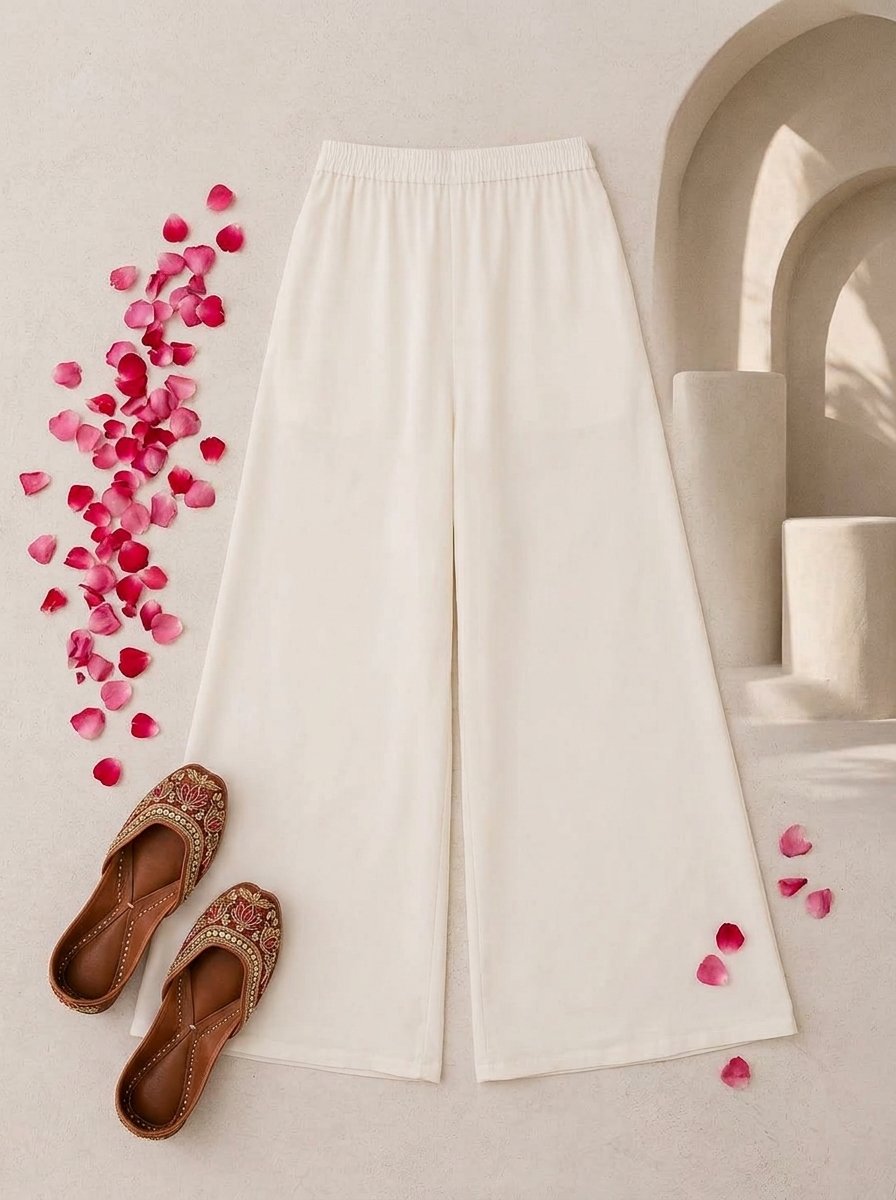
Every piece below arrives in plain white and is dyeable.

White Sharara Pants

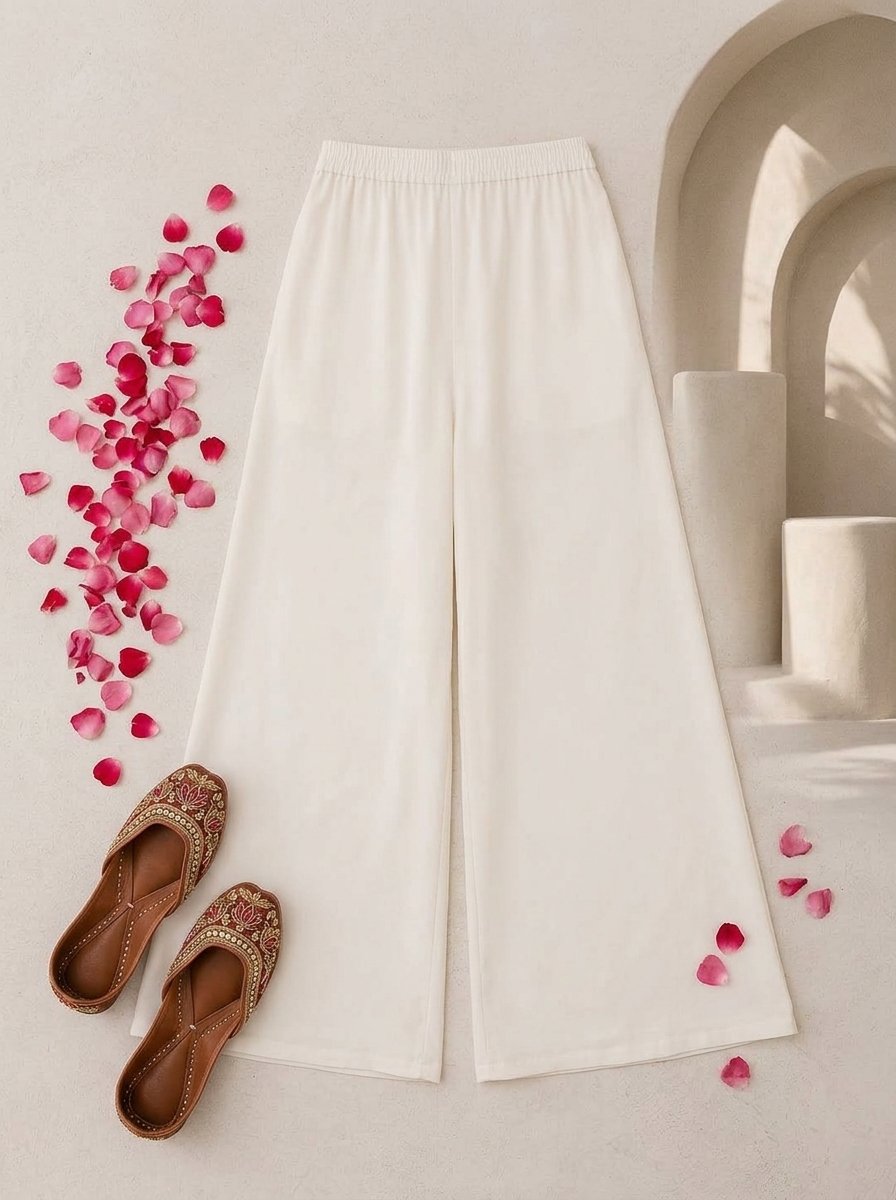
A flare from the waist, with no knee seam. Easy to dance in.

White Gharara Pants

Fitted to the knee, then a wide gathered flare. A traditional mehndi silhouette.

White Culottes Pants

Wide, straight and cropped. A light pick for a dholki or a mayoun.
Shop Eastern Bottoms

FAQ: Mehndi Dresses for Girls

What colour dress should a girl wear to a mehndi?

Bright shades such as yellow, green, orange, coral, fuchsia and teal suit a mehndi. If you know the bride’s colour, choose a slightly different shade.

Can I wear white or black to a mehndi?

Many Pakistani guides advise against both. Faisal Silk says black and pure white are usually avoided for mehndi, and RJ’s Pret says white is associated with mourning. Customs vary, so ask the family.

What is the best silhouette for a mehndi dress?

A sharara set is the most popular and practical, because it is comfortable for sitting, dancing and applying henna. A gharara is another traditional choice.

What should the sister of the bride wear to the mehndi?

Follow the family’s colour scheme, often in matching or complementary sets. Peach, mint and lavender are popular bridesmaid shades. Ask for the theme early.

Can I dye a white sharara for a mehndi?

Yes, if the fabric and thread are dyeable, as ours are. Take your kurti and the white sharara to a dyer, ask for a swatch test and compare in daylight. Dyeing usually costs around Rs. 300, and results depend on the dyer.

What shoes suit a mehndi dress?

Comfortable flats, khussa or embellished juttis suit a mehndi, because you will dance and sit for hours. Choose the pair you can keep on all night.

Choosing Your Mehndi Shade?

Tell us the bride’s colour and your kurti shade on WhatsApp: 03394011360, and we will help you choose a dye shade that does not clash. You can also read about the formal function in Baraat Dresses for Girls, browse the shop or visit our contact page.
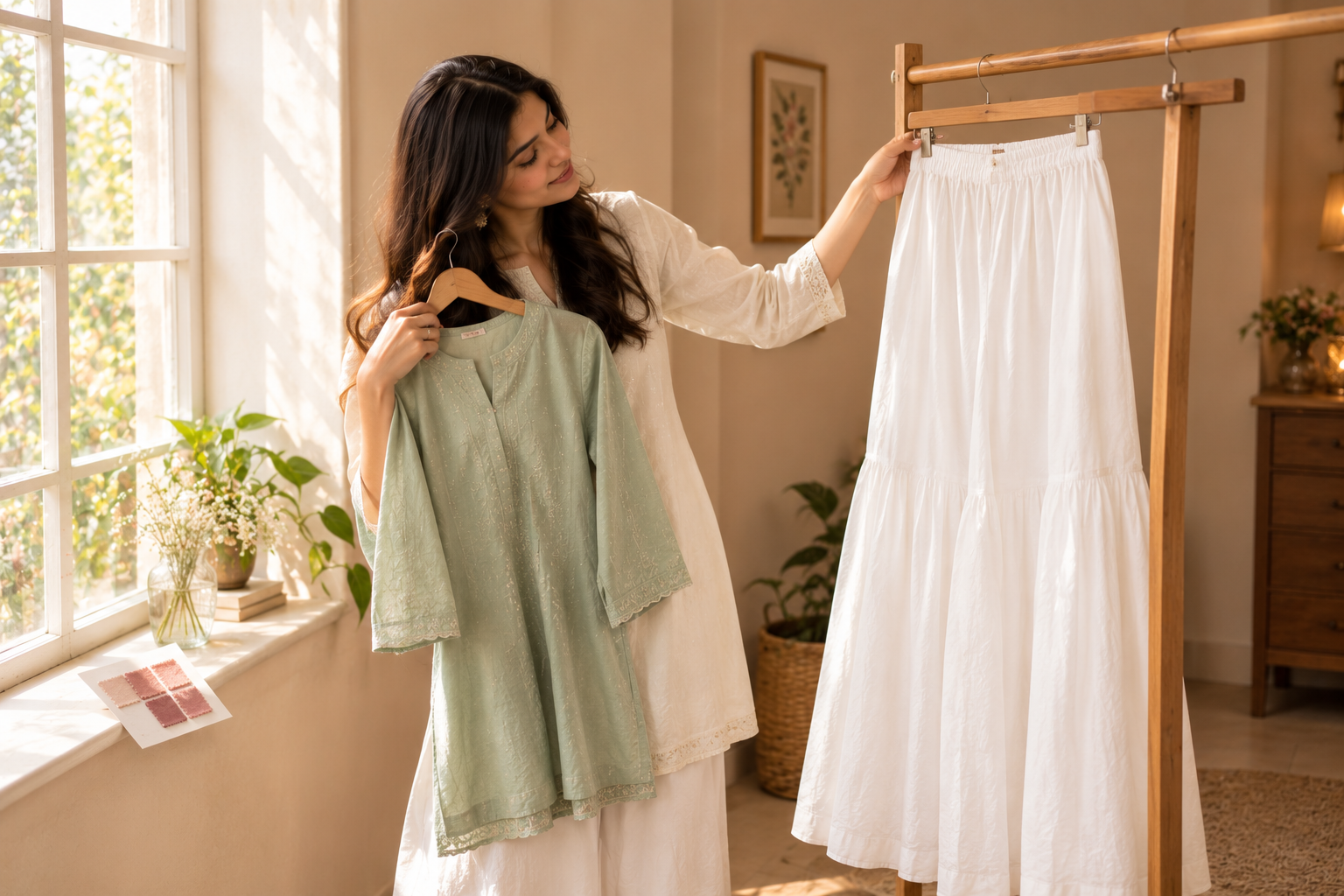
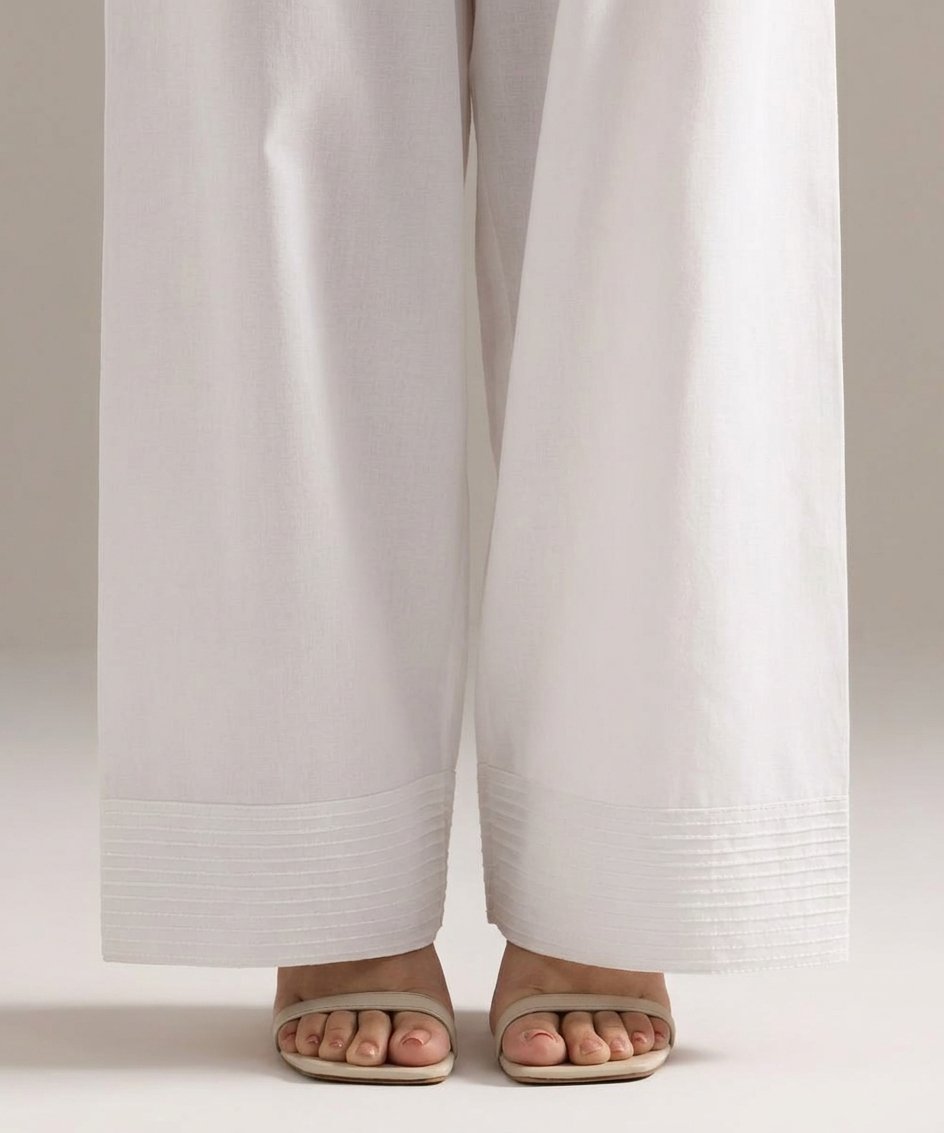
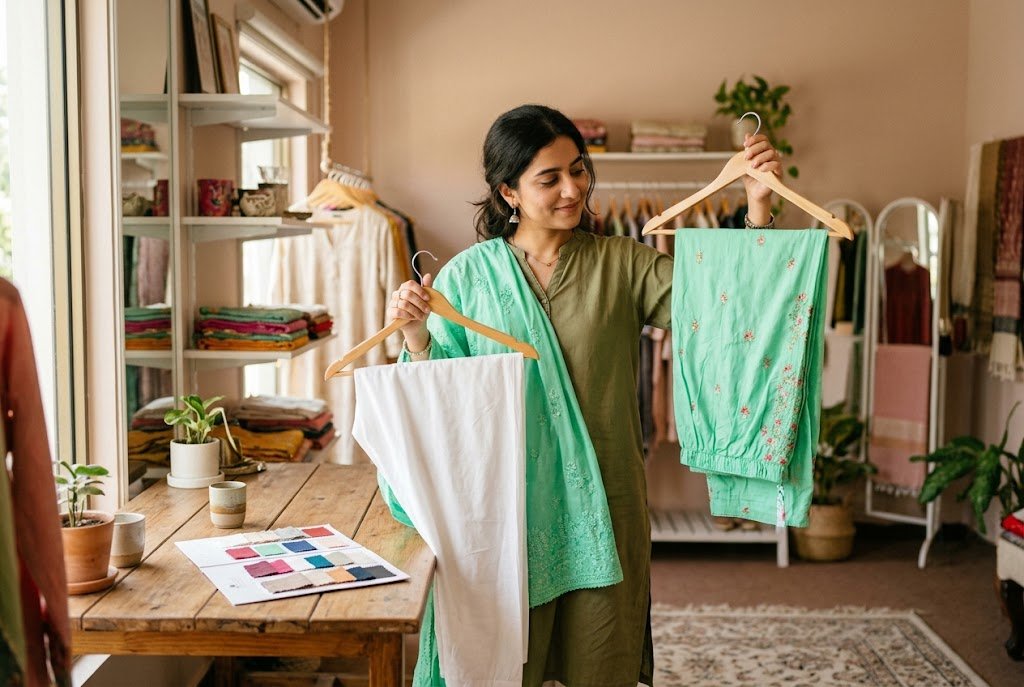
Woman deciding on a white trouser design by holding a sage kurti against white bottoms

White Trouser Design for Girls: 8 Ideas to Wear and Dye in Pakistan

White trouser design gives you two options in one purchase: wear it white, or dye it.

Most trousers force the choice at the shop. A white pair lets you decide at home, with your kameez or kurti in your hand. This guide gives you eight ideas, a simple rule for choosing between white and dyed, and a cost table so you know what each path costs.

Why Is White Trouser Design Getting Attention in 2026?

Pantone named Cloud Dancer, a soft white, its Colour of the Year for 2026, the first white it has ever chosen. Gul Ahmed’s trouser design guide also lists “white trouser design 2026” among its related ideas. Fashion pages are not proof of demand, but they point the same way.

What Is the White-First Rule?

Wear the white pair with your kurti before you dye anything. This is the habit we suggest to every customer.

  1. Put the white bottom with your kurti, and take a photo in daylight.
  2. Ask one question: does the kurti carry the outfit?
  3. If yes, keep the bottom white.
  4. If the outfit looks flat, or you want a tonal look, choose a dye shade.

Our stance: keep at least one white pair in your wardrobe. A calm piece lets everything else lead.

Eight White Trouser Design Ideas to Wear or Dye

Each idea says “wear white” or “dye”, and names the bottom it uses.

1. White farshi with a sage kurti (wear white)

Pair a white farshi shalwar with a sage kurti and a soft ivory dupatta. The white farshi design lets the sage kurti stay the star.

2. White sharara with a bright kurti for mehndi (wear white)

Wear a white sharara with a marigold or fuchsia short kurti. The white calms the colour.

3. White culottes with a printed kurti for university (wear white)

Pair white culottes with a printed short kurti. A white bottom keeps a busy print from fighting.

4. White bell bottom with a fitted kurti (wear white)

Wear white bell bottom pants with a short, fitted kurti in one clear colour.

5. White gharara dyed to match a maroon kurti (dye)

Dye a white gharara one shade deeper than a maroon kurti. Add a gold dupatta for a rich, formal evening look.

6. White sharara dyed teal with marigold (dye)

Dye the sharara teal, and pair it with a marigold kurti. This is a bold, festive contrast.

7. White farshi dyed champagne with ivory (dye)

Dye the farshi a pale champagne, and wear it with an ivory kurti. The look stays soft for a nikkah or walima.

8. White culottes dyed dusty rose for work (dye)

Dye the culottes a soft dusty rose, and pair them with a cream short kurti. It is a quiet office look.

How Do You Style a White Trouser Design Without It Looking Flat?

White can look flat when everything around it is flat too. Try these four moves.

  • Add one accent. A coloured dupatta or jutti gives the eye somewhere to land.
  • Keep one piece calm. Chic Ophicial advises against pairing a voluminous top with an equally voluminous bottom. A structured angrakha with straight, wide-leg trousers balances the look.
  • Mix textures. A matte bottom with a textured kurti looks richer than two flat pieces.
  • Choose a simple trouser design for daily wear. Save the dramatic flare for events.

How Do You Keep a White Trouser Design Looking White?

Sort your washing by colour. Iowa State Extension says washing like colours is the way to prevent colour transfer. So wash your white bottoms with other light pieces, not with dark or new dyed clothes.

If you plan to dye later, keep the piece clean. Dharma Trading’s dyeing guide says dirt, oils and even fingerprints can cause uneven dyeing. After you dye, follow our guide Wash Dyed Bottoms Without Fading.

What Does White Cost Compared With Dyed?

Here are the prices listed on our site today. Check each product page for the current price. Dyeing usually costs around Rs. 300, and wide pieces may be priced differently.

BottomWear whiteDyed (about)
White Farshi ShalwarRs. 1,500Rs. 1,800
White Culottes PantsRs. 1,500Rs. 1,800
White Bell Bottom PantsRs. 1,500Rs. 1,800
White Sharara PantsRs. 2,500Rs. 2,800
White Gharara PantsRs. 2,500Rs. 2,800

Results depend on the dyer, so we never promise an exact shade. For the full process, read How to Dye a White Shalwar to Match Your Shirt and How Much Does It Cost to Dye a Shalwar in Pakistan?.

Which Mistakes Spoil a White Look?

  • White on white with no texture. The outfit looks flat.
  • Two voluminous pieces. Keep either the top or the bottom calm.
  • Dyeing before you test white. You may not need the dye at all.
  • Letting stains sit. Wash early, and keep whites with whites.
  • A near-miss dye shade. Match closely or contrast clearly, but never in between.

Shop the Look: Five White Bases to Wear or Dye

Every piece below arrives in plain white and is dyeable.

White Farshi Shalwar

Wide, pleated and floor-length. See Eid 2027 Outfit Ideas.

White Sharara Pants

A flare from the waist with no knee seam.

White Gharara Pants

Fitted to the knee, then a wide gathered flare. See Pakistani Wedding Outfit Ideas.

White Culottes Pants

Wide, straight and cropped.

White Bell Bottom Pants

Fitted through the hips and thighs, then flared from the knee.

Shop Eastern Bottoms or Shop Western Bottoms

FAQ: White Trouser Design for Girls

What is the best white trouser design for girls?

It depends on the occasion. A farshi suits formal days, a sharara suits festive events, and culottes suit university and work.

What colour kurti goes with a white trouser?

Most colours work, including pastels and jewel tones. Choose one hero colour for the kurti, and let the white bottom and the dupatta support it.

Can I dye a white trouser to match my kurti?

Yes, if the fabric and thread are dyeable, as ours are. Take both to a dyer, ask for a swatch test and compare in daylight. Dyeing usually costs around Rs. 300, and results depend on the dyer.

How do I keep a white trouser white?

Wash it with other light pieces, not with dark or newly dyed clothes. Iowa State Extension says washing like colours is the way to prevent colour transfer.

Is white trouser design in fashion in 2026?

Pantone named a soft white, Cloud Dancer, its 2026 Colour of the Year, and white trouser designs appear in Pakistani fashion guides such as Gul Ahmed’s.

Should I keep my white trouser white or dye it?

Keep it white if the kurti carries the outfit. Dye it if you want a tonal look. Try the white pair with your kurti first, and decide after you see it.

Wear It White or Dye It?

Send us a photo of your kurti on WhatsApp: 03394011360, and tell us the occasion. We will help you decide. You can also visit our contact page, browse the shop or read our story.

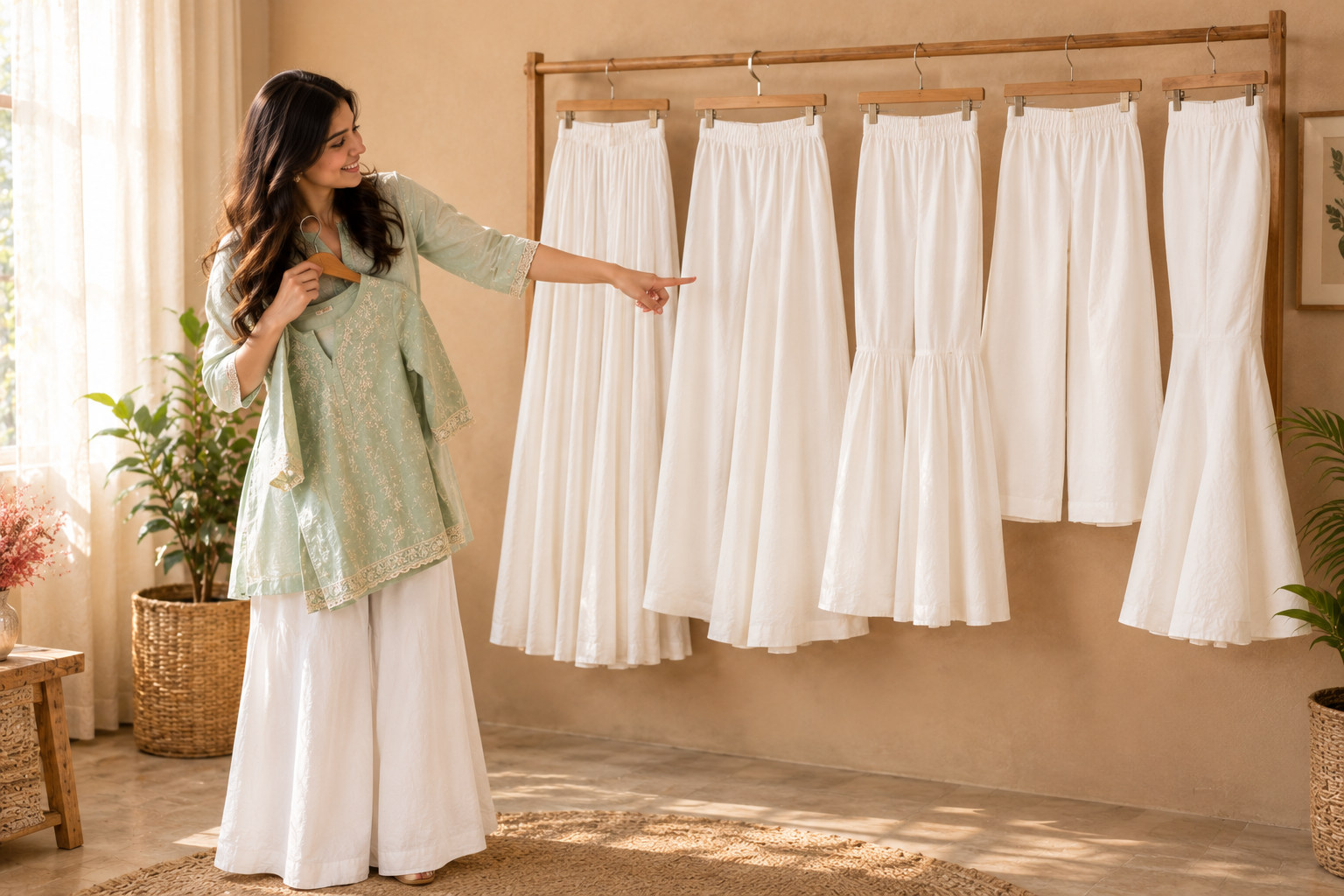
Woman choosing a trouser design for girls from five white silhouettes on a rail

Trouser Design for Girls in Pakistan: 10 Styles, Names and How to Wear Them

Trouser design for girls in Pakistan has a naming problem: ask three tailors for a plazo, and you may get three different trousers.

The words shift between shops, cities and Instagram pages. One person’s “khula” is another person’s “wide”. So this guide gives you ten styles with clear names, a table of kurti pairings and a short brief to hand your tailor. It also shows which of the ten you can buy in plain white from us and dye to match.

What Does Trouser Design Mean in Pakistan Today?

In Pakistan, people look for a trouser design the way they look for a kurti design: by cut, by hem and by detail. Laam’s trouser page lists the terms that come up again and again. They include simple trouser design, fancy trouser design with lace or embroidery, kurta trouser design, shalwar trouser design, cut trouser design and khula trouser design. It also lists palazzo, bell bottom and cigarette pant designs.

Three small words are worth knowing.

  • Poncha (also written paincha) is the hem, or the leg opening.
  • Khula means loose and flowy.
  • Cut means a shaped or edged hem.

Which Trouser Design Is Trending in Pakistan in 2026?

Brand guides point in two directions. Gul Ahmed’s trouser guide says wide-leg embroidered trousers and structured shalwar designs are the strongest directions for girls in 2026. Chic Ophicial’s 2026 trend report says shararas have become less theatrical, with flowing, wide-flared trousers replacing ultra-stiff, heavily gathered ones.

Both are brand views, so treat them as direction, not law.

Ten Trouser Designs for Girls, With Names and Pairings

The table gives each style one line. Five are ours, and five are not. We say so, because you deserve a straight answer. The pairings follow Sapphire’s published kurti rules: straight kurtis suit culottes or straight pants, A-line kurtis suit fitted bottoms, and boxy kurtis suit wide-leg trousers or culottes.

StyleWhat it looks likePair withBest forAt Shalwar & Co
Farshi shalwarWide, pleated, floor-lengthLong or mid kurtiEid, weddingsWhite Farshi Shalwar
ShararaFlares from the waist, no knee seamShort or longMehndi, dawatWhite Sharara Pants
GhararaFitted to the knee, then a flareShort kurtiFormal eveningsWhite Gharara Pants
CulottesWide and croppedShort or midUniversity, workWhite Culottes Pants
Bell bottomFitted, flared from the kneeShort, fittedSmart casualWhite Bell Bottom Pants
Plazo (palazzo)Wide, flares evenly from waist to ankleLong or flowyDaily, dressyNot sold
Tulip shalwarOverlapping hem, like petalsShort to midDaily, festiveNot sold
Dhoti shalwarDraped, gathered at the ankleShortFestiveNot sold
Cigarette pantsSlim, ankle-lengthA-line or straightOffice, dailyNot sold
Straight trouserStraight cut, the simple trouser designAnyDailyNot sold

Capri designs often appear in the same Pakistani searches. Capris are slim and cropped, so they are not the same as wide culottes.

How Do You Describe a Trouser Design to Your Tailor?

Names fail, but measurements do not. Hand your tailor this five-line brief.

  1. Where does the flare start? At the waist, at the knee or only at the hem.
  2. Is there a seam or band at the knee? That points to a gharara.
  3. How wide is the poncha? Give the hem opening in inches.
  4. Is the waist elastic, a drawstring or a belt?
  5. What is the full length? Measure from your waist to the floor, in your shoes.

Add a photo, and mark the part you like. Our guide Which Bottoms Suit Your Height? explains how to measure length for the shoes you will wear.

Which Trouser Design Suits Your Kurti Length?

  • Short kurti: culottes, sharara, gharara, bell bottom and tulip shalwar. The shape stays visible.
  • Mid-length kurti: culottes, farshi, sharara and cigarette pants.
  • Long kurti: farshi, plazo and straight trousers.

One caution comes from Chic Ophicial. A voluminous top needs a calmer bottom, and a voluminous bottom needs a calmer top. So do not pair a big angrakha with a gharara.

Can You Dye a White Trouser Design to Match Your Kurti?

Yes, if the fabric and thread are dyeable, as ours are. Take your kurti and the white pair to a dyer, ask for a swatch test, and check it in daylight. Dyeing usually costs around Rs. 300, but wide pieces such as a gharara or sharara may be priced differently, so ask first.

Results depend on the dyer, so we never promise an exact shade. For the steps, read How to Dye a White Shalwar to Match Your Shirt and How Much Does It Cost to Dye a Shalwar in Pakistan?. If you are unsure whether to dye at all, Dyeable vs Ready-Made Shalwar gives you a five-question test.

Which Mistakes Spoil a Trouser Design?

  • Choosing by name alone. Check where the flare starts and how wide the hem is.
  • Two heavy pieces. Keep either the top or the bottom calm.
  • Wrong length for your shoes. Measure in the shoes you will wear.
  • A near-miss colour. Match your kurti closely or contrast it clearly, but never in between.
  • Skipping the swatch test. A small test shows the real shade before the whole piece goes in.

Shop the Look: Five Trouser Designs in Dyeable White

Every piece below arrives in plain white and is dyeable.

White Farshi Shalwar

Wide, pleated and floor-length. The classic for Eid and weddings.

White Sharara Pants

A flare from the waist with no knee seam. Easy to dance in. See Sharara Outfit Ideas for Mehndi and Dawat.

White Gharara Pants

Fitted to the knee, then a wide gathered flare. A formal pick.

White Culottes Pants

Wide, straight and cropped. A light pick for university and work.

White Bell Bottom Pants

Fitted through the hips and thighs, then flared from the knee.

Shop Eastern Bottoms or Shop Western Bottoms

FAQ: Trouser Design for Girls

What is the latest trouser design for girls in Pakistan?

Wide-leg and structured shalwar designs lead for 2026, according to Gul Ahmed’s trouser guide. Chic Ophicial adds that shararas are becoming more fluid and less stiff.

What is a simple trouser design for daily wear?

A straight trouser, culottes or a plain shalwar suits daily wear. Plain, breathable designs are the easiest to wear every day.

What is the difference between plazo and sharara?

A plazo, or palazzo, is a long, loose wide-leg pant that flares evenly from the waist. A sharara also flares from the waist, but it comes from South Asian festive wear and is often worn with a kurti and dupatta. Sellers sometimes use the two names loosely, so check the photo.

What is a bell bottom trouser design?

A bell bottom is fitted through the thigh and flares from the knee. Laam lists it among Pakistan’s trendy trouser designs as a vintage trend making a comeback.

Which trouser design suits a short kurti?

Culottes, sharara, gharara and bell bottom suit short kurtis, because the shape stays visible. Keep the kurti fitted and the bottom wide.

Can I dye a white trouser to match my kurti?

Yes, if the fabric and thread are dyeable, as ours are. Take both to a dyer, ask for a swatch test and compare in daylight. Dyeing usually costs around Rs. 300, and results depend on the dyer.

Not Sure Which Trouser Design to Start With?

Send us your kurti length and the occasion on WhatsApp: 03394011360, and we will suggest a design. You can also visit our contact page, browse the shop or read our story.

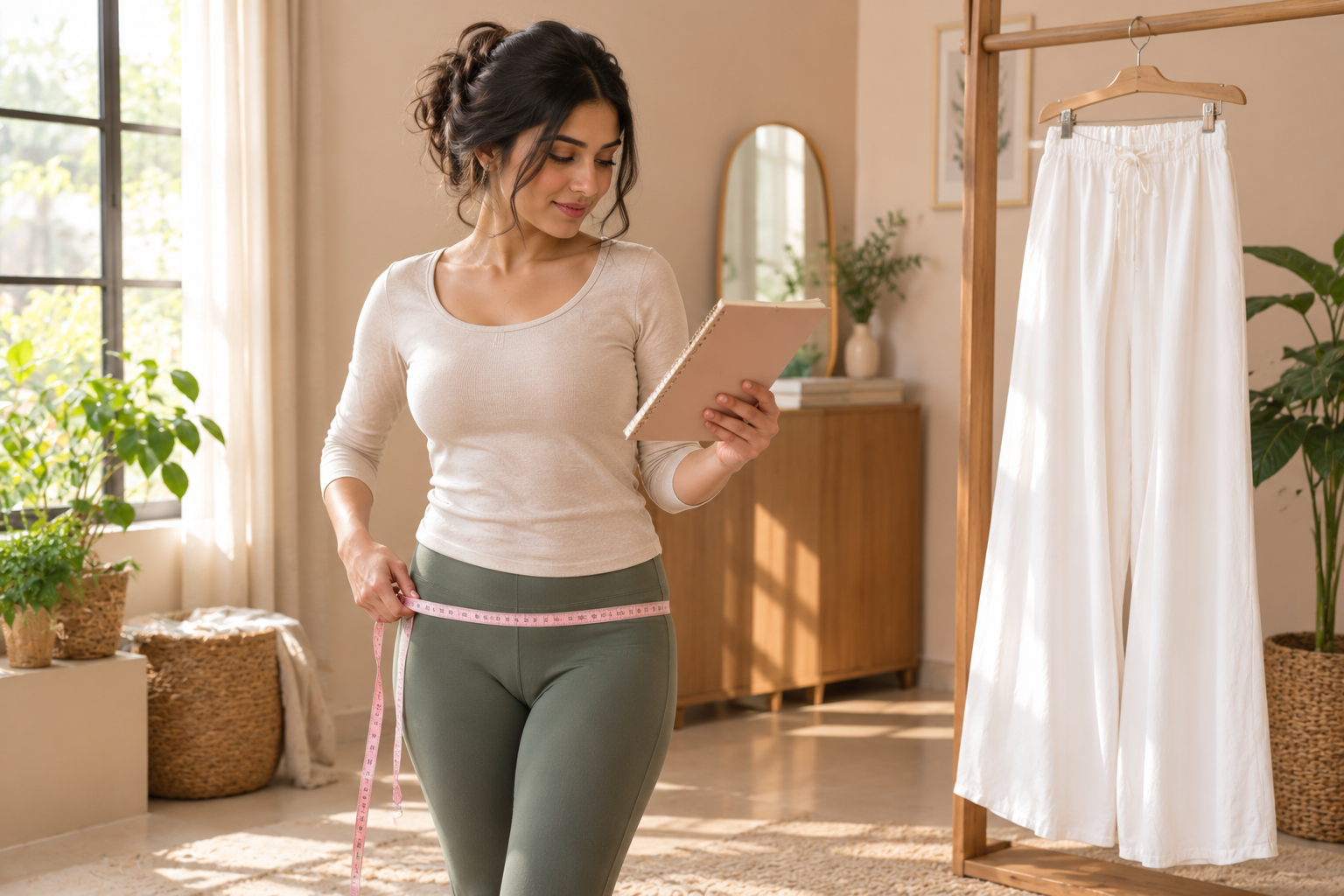
Woman showing how to measure yourself for bottoms with a soft tape and a notebook

Measure Yourself for Bottoms: A Style-by-Style Guide

Measure yourself for bottoms before you order, because a size chart is useless without your own numbers.

A label such as “medium” means different things at different shops. Your tape does not change. So take five measurements once, write them down, and use them every time you shop online. It takes about ten minutes, and it saves you a return.

What Do You Need Before You Start?

Gather four things.

  • A soft tape measure, not a metal one.
  • A notebook or a notes app on your phone.
  • Light, close-fitting clothes, so you measure your body and not your outfit.
  • A friend, for the length measurements that are hard to take alone.

Stand straight and relax. Do not pull the tape tight, and do not hold your breath.

How Do You Measure Yourself for Bottoms?

Follow the points in New Mexico State University Extension’s pants guide. It lists the measurements below.

  1. Waist. Measure the smallest part of your waist. NMSU suggests leaving the tape tied snugly there while you take other measurements.
  2. Hip. Measure around the fullest part of your hips and seat. Keep the tape level.
  3. Thigh. Wrap the tape around your thigh, just below the crotch. This matters for fitted styles.
  4. Length. Measure from your waist down the side of the leg to the length you want.
  5. Your event shoes. Wear the shoes you will wear with the outfit when you measure length, because heels and flats change the hem you need. Our guide Which Bottoms Suit Your Height? explains why.

Take every number twice. If the two do not match, take a third.

Which Measurements Matter for Each Style?

This is the part most size guides skip. Different silhouettes need different numbers. The table is our guidance, so check each product page for its own measurements.

StyleMeasure theseWhy
FarshiWaist, hip, waist to floorA floor-length hem needs an exact length
ShararaWaist, hip, waist to floorA flare from the waist needs the right hem
GhararaWaist, hip, waist to knee, waist to floorThe knee joint should sit at your knee
CulottesWaist, hip, waist to where you want the cropThe crop point decides the look
Bell bottomWaist, hip, thigh, waist to floorThe cut is fitted to the knee, so thigh matters

Why Should You Measure a Pair That Already Fits?

It is the easiest check of all. Size.ly’s pants guide describes it. Lay a pair you love flat and fastened. Measure across the waist, hip and thigh, then double those numbers to get a body circumference. Leave the length as a single run.

Then compare these numbers with the seller’s chart. If the chart’s waist, hip and length are close to your trusted pair, you can order with more confidence.

One nuance applies to shalwars. If the waist has elastic or a drawstring, it can stretch or tighten, so ask the seller which waist measurement the chart shows. Check the product page, or ask us.

What If You Are Between Sizes?

Start with your hip. Made by Rae’s pants guide says to choose the size from the hip measurement, then check your waist. If your waist puts you in a larger size, use the larger one.

Then check the length. A size that fits your hip but ends too short is still the wrong size.

[INSERT: your real garment measurements for each product and size, including waist, hip, length and hem width.]

What Should You Ask a Seller Before You Order?

A size label is not enough. Ask these seven questions.

  • What are the garment measurements for each size?
  • Is the waist elastic or a drawstring?
  • What is the full length from waist to hem?
  • How wide is the hem?
  • Is the fabric pre-shrunk, and may it shrink after dyeing and washing?
  • Which measurement does the chart show, waist stretched or relaxed?
  • Can I send my numbers and ask which size you suggest?

If you plan to dye, remember that dyeing involves washing. Our guide Wash Dyed Bottoms Without Fading explains the first washes, and How to Dye a White Shalwar to Match Your Shirt covers the dye day.

[INSERT PHOTO: a real photo of a customer or team member measuring with a soft tape.]

Which Mistakes Ruin a Measurement?

  • Measuring over thick clothes. You measure the clothes, not you.
  • Pulling the tape tight. A tight tape gives numbers that are too small.
  • Measuring the hip too high. Find the fullest part of your hips and seat.
  • Using the wrong shoes for length. Wear your event shoes.
  • Ordering by the label alone. Always compare garment measurements.
  • Forgetting to write the numbers down. Keep them in your phone for the next order.

Shop With Your Numbers

Every piece below arrives in plain white and is dyeable. Check each product page for its measurements.

White Farshi Shalwar

Wide, pleated and floor-length. Compare your waist-to-floor number.

White Sharara Pants

A flare from the waist with no knee seam.

White Gharara Pants

Fitted to the knee, then a wide gathered flare. Compare your waist-to-knee number.

White Culottes Pants

Wide, straight and cropped. Choose where the crop lands.

White Bell Bottom Pants

Fitted through the hips and thighs, then flared from the knee.

Shop Eastern Bottoms or Shop Western Bottoms

FAQ: Measure Yourself for Bottoms

How do I measure myself for bottoms?

Use a soft tape and light clothes. Measure your waist at its smallest part, your hips at their fullest part, your thigh just below the crotch, and the length from your waist to where you want the hem. Write each number down.

Where do I measure my waist for bottoms?

Measure the smallest part of your waist, which is your natural waistline. Keep the tape level and snug, but do not pull it tight.

Which measurement matters most for bottoms?

Many fitting guides choose the size from the hip measurement, then check the waist. Length also matters for long styles such as a farshi or sharara.

How do I choose between two sizes?

Start with your hip. If your waist suggests a larger size than your hip does, use the larger size, then check that the length suits you.

How do I measure the length for a farshi or sharara?

Wear your event shoes, and measure from your natural waist down to the floor. Compare that number with the product’s length.

Should I measure a pair that already fits?

Yes. Lay it flat and fastened, measure across the waist, hip and thigh, and double those numbers. Then compare them with the seller’s chart.

Not Sure About a Number?

Message us on WhatsApp: 03394011360 and ask. You can also visit our contact page or browse the shop.

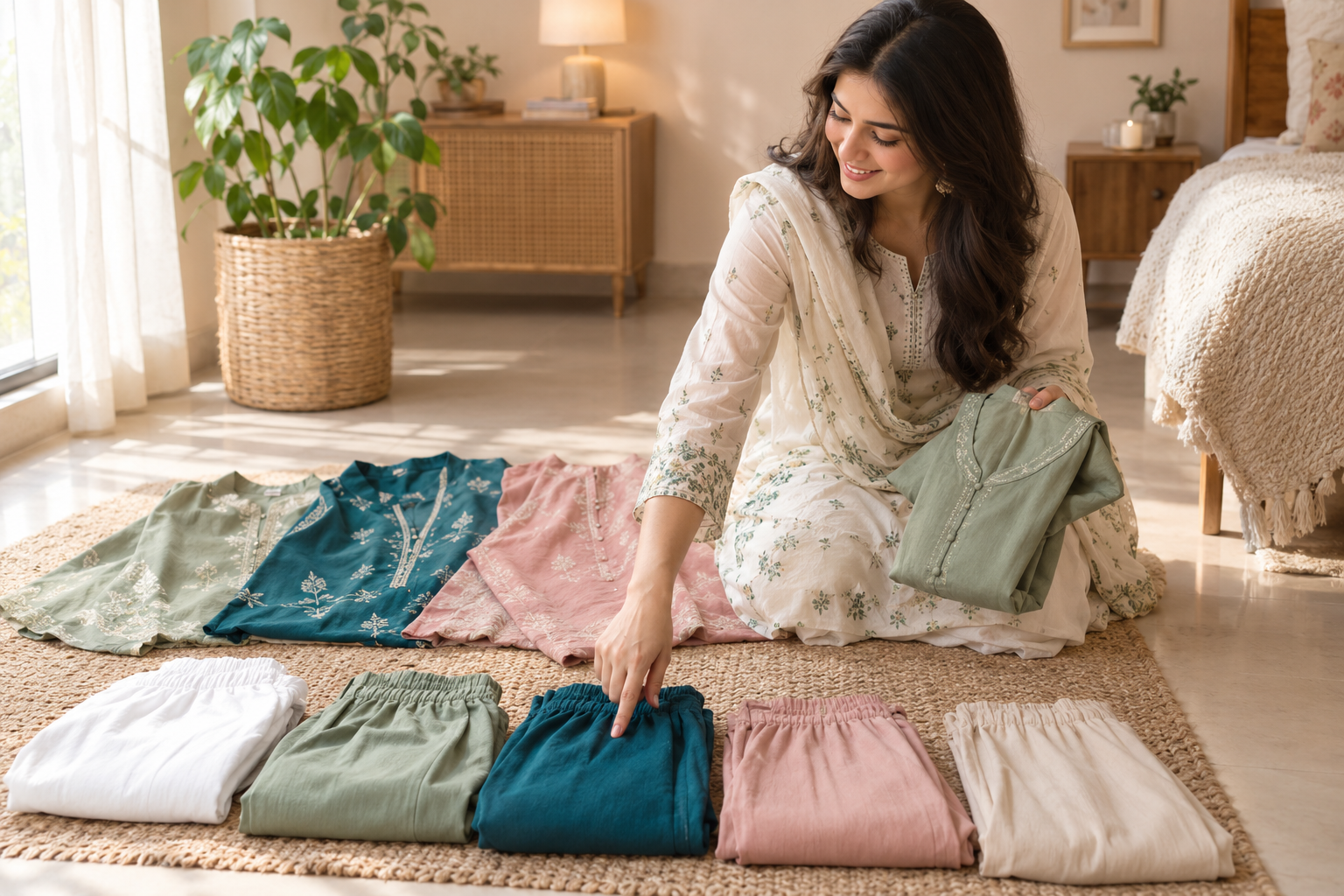
Woman arranging five bottoms and three kurtas to plan a Pakistani capsule wardrobe

Pakistani Capsule Wardrobe: 5 Bottoms and 15 Outfits

A Pakistani capsule wardrobe works best when you build it from the bottom up: five bottoms and three kurtas give you fifteen outfits on paper.

That number sounds too good, so we checked it. In the table below, 13 of those 15 pairings work, and 7 are standouts. Two do not, and we say which. The point is simple. Bottoms are the pieces most people replace, mismatch and forget. So build around them, and the rest of the wardrobe gets easier.

What Is a Capsule Wardrobe, and Why Start With Bottoms?

Wikipedia’s entry on the capsule wardrobe explains the idea. Designer Susie Faux described it as a few essential items that do not go out of fashion, which you then add seasonal pieces to. Most guides list “a pair of tailored trousers” as the bottoms.

That works for a Western wardrobe. A Pakistani wardrobe has far more variety below the kurta. Habiba Minhas’ capsule guide starts from the suit, which is sensible. We start from the bottom, because that is the piece most likely to clash with everything, as our guide Why Your Shalwar Never Matches Your Kameez (and the Fix) explains.

Which Five Bottoms Build the Capsule?

Each bottom gets one job. Prices are the ones listed on our site today, so check each product page for the current price.

BottomIts jobBest kurta lengthPrice
CulottesEveryday, university, workShort to midRs. 1,500
Bell bottomSmart casual, retro lineShort, fittedRs. 1,500
ShararaMehndi, dawat, festiveShort or longRs. 2,500
FarshiEid, weddings, formal daysLong or midRs. 1,500
GhararaFormal evenings, nikkahShortRs. 2,500

How Many Outfits Do Five Bottoms Really Make?

The maths is multiplication. Judyp Apparel’s module method shows it with two bottoms and three tops giving six combinations. So five bottoms and three kurtas give fifteen.

But not every pairing works. Sapphire’s bottoms guide says straight kurtis suit culottes or straight pants, A-line kurtis suit fitted bottoms, and boxy kurtis suit wide-leg trousers or culottes. We used those rules as a base for this table. It is our styling suggestion, not a law.

  • Kurta A: a short, straight, fitted kurta
  • Kurta B: a mid-length A-line kurta
  • Kurta C: a long or boxy kurta
Kurta AKurta BKurta C
CulottesStandoutWorksStandout
Bell bottomStandoutStandoutSkip: hides the flare
ShararaStandoutWorksWorks
FarshiWorksWorksStandout
GhararaStandoutWorksSkip: hides the flare

That makes 13 workable pairings and 7 standouts. Swap two dupattas in, and the outfit count roughly doubles.

Which Bottoms Should You Dye, and Which Should Stay White?

Dye for your kurtas, not for the trend. Look at the three kurtas you chose, and note the colours that appear in at least two of them. Those are your dye shades.

Here is a starter plan.

  • Leave one white. A white bottom lets any kurta lead. The farshi is a good candidate.
  • Dye one soft neutral. Sage, champagne or dusty rose works with many kurtas.
  • Dye one hero. Choose a deeper shade for the sharara or gharara.

Dyeing usually costs around Rs. 300 per piece, and wide pieces may be priced differently. Results depend on the dyer, so we never promise an exact shade. For the full process, read How to Dye a White Shalwar to Match Your Shirt. For a fair look at when dyeing is not the answer, read Dyeable vs Ready-Made Shalwar.

What Does the Capsule Cost?

At the listed prices, all five bottoms cost Rs. 9,500. Dyeing all five adds around Rs. 1,500, so the total is around Rs. 11,000. Spread over the 13 workable outfits, that is around Rs. 850 per outfit, before kurtas and dupattas.

You do not need to buy all five at once. A starter set costs less.

What Is the Three-Wear Rule?

This is our own rule. Before you buy bottom number six, make sure each bottom you own earns at least three outfits. If one bottom sits unused, the fix is a new kurta or dupatta, not another bottom.

It also stops you from dyeing a shade you will only wear once. Look at Pakistani Wedding Outfit Ideas and Eid 2027 Outfit Ideas for ways to reuse one bottom across events.

Which Mistakes Break a Capsule?

  • Five loud colours. Pick two or three shades that repeat in your kurtas.
  • Ignoring kurta length. A long kurta hides a flare, so check the table.
  • No white or neutral. You need one calm piece to let others stand out.
  • Skipping the swatch test. A small test shows the real shade before you dye.
  • Buying by height-blind guesses. Check lengths first. Our guide Which Bottoms Suit Your Height? helps.

Shop the Capsule

Every piece below arrives in plain white and is dyeable.

White Culottes Pants

Wide, straight and cropped. The everyday anchor.

White Bell Bottom Pants

Fitted through the hips and thighs, then flared from the knee.

White Sharara Pants

A flare from the waist with no knee seam. The festive workhorse.

White Farshi Shalwar

Wide, pleated and floor-length. The formal anchor.

White Gharara Pants

Fitted to the knee, then a wide gathered flare.

Shop Eastern Bottoms or Shop Western Bottoms

FAQ: Pakistani Capsule Wardrobe

What is a capsule wardrobe?

A capsule wardrobe is a small collection of essential pieces that do not go out of fashion, which you mix and match and add seasonal items to. The idea comes from designer Susie Faux.

How many bottoms does a Pakistani capsule wardrobe need?

Three bottoms are a good start, and five give plenty of variety. Choose bottoms for different jobs: everyday, festive and formal.

Which bottom is the most versatile?

We would choose culottes for everyday wear. A white bottom, such as a farshi, also pairs easily with many kurtas.

How many outfits do five bottoms and three kurtas make?

Five bottoms and three kurtas make fifteen combinations on paper. In our table, 13 work and 7 stand out.

Should I dye all my bottoms?

Not necessarily. Leave one white, dye one soft neutral, and dye one hero shade chosen from the colours in your kurtas.

How much does a capsule of bottoms cost?

At Shalwar & Co’s listed prices, five white bottoms cost Rs. 9,500, and dyeing adds around Rs. 300 each. A three-bottom starter capsule costs about Rs. 6,100 with two pieces dyed.

Starting Small?

Tell us your three kurta colours on WhatsApp: 03394011360, and we will suggest which bottoms to start with. You can also browse the shop or read our story.

Woman comparing a ready-made mint shalwar with a white dyeable shalwar: dyeable vs ready-made

Dyeable vs Ready-Made Shalwar: Which Should You Buy?

Dyeable vs ready-made shalwar is not a contest with one winner. We sell dyeable ones, and we still say dyeing is not always the smarter move.

Picture the scene. You hold a mint kurta in a shop, and the nearest mint shalwar is one shade too blue. You can buy it and hope, or you can start from white and make the shade yourself. Both choices are fair. The right one depends on a few questions, and we will give you the test below.

What Is the Real Difference Between Dyeable and Ready-Made Shalwar?

A ready-made shalwar arrives in a fixed colour, chosen by the brand. A dyeable shalwar arrives in plain white, with dye-friendly fabric and thread, and you choose the colour afterwards.

The idea is not unique to us. Pakistani label Generation lists a Dyeables Shalwar, described as made with dye-friendly fabric and thread, so you can wear it as is or dye it to match an outfit. Its dyeables line also includes straight-fit pants and undershirts. We focus on the silhouettes people ask for in festive and wedding season: farshi, gharara, sharara, culottes and bell bottom.

Dyeable vs Ready-Made Shalwar: Where Does Each Win?

FactorReady-madeDyeable
Colour choiceA fixed paletteAny shade your dyer can make
See the final colour firstYes, before you payOnly after a swatch test
TimeSame dayYour dyer’s turnaround
CostThe price tagThe price tag plus around Rs. 300
Match riskShades can shift between batches and lightingDepends on the dyer, so test first
First washesMay bleed too, so follow the tagWash separately at first
Best forCommon shades and tight deadlinesExact or unusual shades

A few notes on the table.

  • Batches. Small differences in temperature and dyeing time can create different shades of the same colour between dye lots, according to Apparel Search. So two “same colour” pieces from different batches may not match.
  • Light. Colours that match under one light can fail under another. RMIT’s colour theory course calls this metamerism. It affects both options.
  • Bleeding. Iowa State Extension says garments tagged “wash separately” will bleed. That applies to ready-made pieces too.

The Five-Question Test: Should You Dye It?

Answer yes or no. This is our judgement, not a formula.

  1. Do you have the exact kurta with you?
  2. Is the shade unusual or hard to find?
  3. Is the event more than a couple of weeks away?
  4. Do you have a dyer you trust?
  5. Will you wear the outfit more than once?

Our stance: four or five yeses mean dye it. Two or fewer mean buy ready-made, and be glad. Three yeses mean either choice works, so decide by cost and time.

What Does Each Option Really Cost?

Ready-made costs the price tag. It also costs the time you spend hunting across shops, and the price of “close enough” when you settle. Dyeable costs the listed price, plus around Rs. 300 for dyeing, plus a trip to the dyer.

Here are the sums at the prices listed on our site today. Check each product page for the current price.

Now compare that total with the ready-made price of the shade you actually want. If you cannot find that shade, the comparison ends there. Dyer rates vary, and wide pieces may be priced differently.

When Should You Skip Dyeing?

Dyeing is not always right. Skip it in these cases.

  • You need the outfit tomorrow. A dyer needs time.
  • The shade is common and easy to find. Buy it and save the trip.
  • You cannot reach a trusted dyer. An untested dyer is a risk.
  • You want to see the final colour before you pay. Ready-made shows you first.
  • You want a very deep shade. Ask a dyer first, because results depend on the dye.

Which Mistakes Spoil Either Choice?

Results depend on the dyer, so we never promise an exact shade.

Shop the Look: Start With a White Base

Every piece below arrives in plain white and is dyeable.

White Farshi Shalwar

Wide, pleated and floor-length.

White Sharara Pants

A flare from the waist with no knee seam.

White Gharara Pants

Fitted to the knee, then a wide gathered flare.

White Culottes Pants

Wide, straight and cropped.

Shop Eastern Bottoms

FAQ: Dyeable vs Ready-Made Shalwar

What is the difference between dyeable and ready-made shalwar?

A ready-made shalwar arrives in a fixed colour. A dyeable shalwar arrives in plain white, made with dye-friendly fabric and thread, so you choose the colour afterwards.

Is a dyeable shalwar cheaper than a ready-made one?

It depends. A dyeable shalwar costs its listed price plus dyeing, which usually costs around Rs. 300. Compare that total with the ready-made price of the shade you actually want.

Is a dyed shalwar as colourfast as a ready-made one?

Both can bleed in early washes. Iowa State Extension says garments tagged “wash separately” will bleed. A freshly dyed piece needs the same care, so wash it alone in cold water at first.

Can a dyer match my kurta exactly?

A good dyer can match closely, but results depend on the dyer, the dye and the fabric. We never promise an exact shade, so test a swatch first.

When should I buy ready-made instead of dyeing?

Buy ready-made when you need the outfit quickly, the shade is common, or you want to see the final colour before you pay.

Do other Pakistani brands sell dyeable shalwars?

Yes. Generation lists a Dyeables Shalwar and straight pants made with dye-friendly fabric and thread. Shalwar & Co focuses on farshi, gharara, sharara, culottes and bell bottom in white.

Not Sure Which Side You Are On?

Send us your kurta colour and your event date on WhatsApp: 03394011360, and we will tell you honestly whether dyeing makes sense for you. You can also visit our contact page or read our story.

Woman hand washing a dyed bottom in cold water to wash dyed bottoms without fading

Wash Dyed Bottoms Without Fading: A First-Wash Guide

Wash dyed bottoms on their own the first time, in cold water, and expect some colour in the water. Skip that step, and a fresh shade can end up on your white clothes.

It is an easy step to skip. A new outfit feels like it should simply be washable. But a freshly dyed piece can still release loose dye, and the early washes are where most trouble starts.

Why Does a Dyed Bottom Bleed or Fade?

Iowa State University Extension explains two problems. Bleeding is loose dye leaving the fabric in the wash. Fading is the slow loss of colour through wear, friction and care.

Here is what it says about each one.

  • Bleeding: if a garment is tagged “wash separately”, expect the dye to bleed. Wash it alone the first time and note what you see in the water.
  • Fading: friction, bleach and light all add to it. It is more of a problem with natural fibres such as cotton, wool and silk than with synthetics.

So the plan is simple. Wash alone at first, keep the water cold, and avoid bleach and strong sun.

How Do You Wash Dyed Bottoms the First Time?

Follow these seven steps.

  1. Ask your dyer first. Dyes differ, so their advice for their own dye comes first.
  2. Wash it alone. Never mix it with your other clothes.
  3. Use cold water. Iowa State advises cool or cold water to keep fading to a minimum.
  4. Use a mild detergent. Skip bleach and strong stain removers.
  5. Check the water. Is it clear, lightly tinted or dark?
  6. Dry in the shade. Avoid the tumble dryer, which can pass colour to the drum, and avoid strong sun.
  7. Repeat. Wash it alone again until the water stays clear.

Keep a first-wash log

This is the habit we suggest to every customer. After each of the first washes, write one line in your phone: the date and the colour of the water. A clear log tells you when the piece is ready to join your normal laundry. It also gives you something concrete to show your dyer if the colour keeps running.

What Should You Ask Your Dyer About Care?

Ask these five questions at pickup.

  • Which dye did you use for this fabric?
  • Should I wash it alone, and for how many washes?
  • Is cold water enough, or is warm fine?
  • Do you use a fixative on it?
  • Can I iron it, and at what heat?

How Do You Wash Dyed Bottoms After the First Few Washes?

Once the water runs clear, switch to a gentle routine.

  • Wash with like colours. Iowa State says this is the only way to prevent colour transfer.
  • Keep using cool or cold water.
  • Skip bleach.
  • Dry away from strong sunlight.
  • Follow any care tag your dyer gives you.

How Do You Care for a Pleated Farshi or Sharara?

Pleated pieces hold their shape best with a little care. Iron them on the reverse side at medium heat, and hang or fold them loosely. This keeps the pleats crisp and avoids shine on the surface.

Our own pieces include a White Farshi Shalwar and White Sharara Pants. Both are wide and pleated, so they reward a gentle routine.

What Is a Dye Fixative, and Should You Use One?

Iowa State notes that dye fixatives such as Retayne and Rit ColorStay reduce colour bleeding in cotton. They are used before the first laundering. However, do not add any product without asking. Ask your dyer whether they use one, and follow their advice.

Which Mistakes Spoil a Dyed Bottom?

  • Washing it with whites. Loose dye can stain them.
  • Using hot water. It makes dye release more likely.
  • Using bleach. It adds to fading.
  • Drying in strong sun or a tumble dryer. Light fades colour, and the dryer can pass colour to the drum.
  • Skipping the dyer’s advice. Your dyer knows their own dye.

Results depend on the dyer and the dye, so none of this replaces their advice. To plan your next dye job, read How to Dye a White Shalwar to Match Your Shirt and How Much Does It Cost to Dye a Shalwar in Pakistan?

Shop the Look: Bottoms Worth Caring For

Every piece below arrives in plain white and is dyeable.

White Farshi Shalwar

Wide, pleated and floor-length.

White Sharara Pants

A flare from the waist with no knee seam.

White Gharara Pants

Fitted to the knee, then a wide gathered flare.

White Culottes Pants

Wide, straight and cropped.

Shop Eastern Bottoms

FAQ: Wash Dyed Bottoms

How do I wash dyed bottoms the first time?

Wash them alone in cold water with a mild detergent, and look at the colour of the water. Dry them in the shade. Repeat separate washes until the water stays clear.

Why does my dyed shalwar bleed?

Loose dye comes out in the early washes. Iowa State Extension says that when a garment is tagged “wash separately”, you should expect the dye to bleed.

Can I wash dyed bottoms with other clothes?

Not at first. Later, wash them with like colours, because washing like colours is the only way to prevent colour transfer.

Does cold water really help?

Yes. Iowa State Extension advises cool or cold water to keep fading to a minimum.

How do I stop a dyed shalwar from fading?

Follow your dyer’s care advice, use cold water, and avoid bleach and strong sunlight. Friction also adds to fading, so wash gently.

Can I use a dye fixative?

Fixatives such as Retayne or Rit ColorStay are sold to reduce bleeding in cotton, according to Iowa State Extension. Ask your dyer before you use any product.

Planning a Dye Job?

Message us on WhatsApp: 03394011360 with the colour you have in mind, and we will tell you what to ask your dyer. You can also visit our contact page or browse the shop.

Woman choosing between two dupattas for Eid 2027 outfit ideas with a dyed sharara

Eid 2027 Outfit Ideas

Eid 2027 outfit ideas start with your calendar, not a shopping list.

Write down what you will really do. Chand raat. Eid morning. One family lunch. One evening dawat. That is four moments, and most people need two or three outfits for them, not ten.

Then check the dates. Wego’s Ramadan 2027 guide expects Ramadan to begin around 8 or 9 February in Pakistan and Eid ul-Fitr around 9 or 10 March. The final dates depend on moon sighting. That still leaves a few months, which is plenty of time to dye a bottom without rushing.

What Is Trending for Eid, According to Pakistani Brands?

Brand guides agree on a simple split. Treat them as direction, not rules.

  • Pastels by day, jewel tones by night. Chic Ophicial’s Eid guide lists lavender, mint green and powder blue for daytime. It lists emerald green and deep plum for evening.
  • Short kurtis with ghararas, and quieter embroidery. RJ’s Pret’s Eid trend guide names short kurtis with ghararas and minimal tone-on-tone embroidery.
  • Sharara and gharara for first-day gatherings. Hooraine’s guide says they suit first-day gatherings, larger family events and dressier evenings.

How Do You Plan Eid 2027 Outfit Ideas Around Your Real Calendar?

Hooraine warns that the easiest mistake is buying for imaginary plans instead of your real calendar. So count your moments first. Then give each one a bottom, a shade direction and a pair of shoes.

This table is our styling suggestion, not a rule.

MomentMoodBottomShade directionFootwear
Chand raatBright and easySharara or culottesBright, or a metallic accentComfortable flats
Eid morningSoft and modestFarshiPastelJuttis or sandals
Family visitsWarm and festiveFarshi or ghararaPastel with goldJuttis
Evening dawatLighter and polishedCulottes or shararaRicher, or understatedShoes you can sit in

Can One Dyed Bottom Cover Two Events?

Yes, if you swap the dupatta. Habiba Minhas notes that many people change into something lighter and more comfortable for an evening dawat. So keep the dyed bottom, and change the mood on top.

One more tip comes from Mishuuu’s Eid guide: if you wear heavy jewellery, choose a slightly softer outfit colour. Otherwise the look gets too loud.

Look 1: Mint on mint (Match)

  • Day: a mint kurta with a farshi dyed the same mint, and an ivory dupatta.
  • Evening: swap to a champagne organza dupatta.

Look 2: Powder blue over white (Contrast)

  • Day: a powder blue kurta with a plain white sharara and a pale blue dupatta.
  • Evening: swap to a silver dupatta.

Look 3: Lilac, one shade deeper (Deepen)

  • Day: a lilac kurta with culottes dyed one shade deeper.
  • Evening: swap to a gold dupatta and add jewellery.

Look 4: Emerald for the evening (Match)

  • Day: an ivory kurta with a gharara dyed emerald, and a light dupatta.
  • Evening: add a gold dupatta, since emerald is a jewel tone for evening.

[INSERT PHOTO: a real day-to-night swap on one dyed bottom, with the same bottom and two different dupattas.]

When Should You Dye for Eid 2027?

Work backwards from Eid. This is our suggested timeline, not a dyer’s schedule, so ask your own dyer first.

  1. Early January: choose a hero colour for each outfit.
  2. Mid to late January: take your kurta to the dyer for a swatch test.
  3. Before Ramadan starts, around 8 or 9 February: drop off the bottom. Dyers may be busier closer to Eid, so ask for a pickup date.
  4. Two weeks before Eid: try the full outfit with shoes and jewellery.

Here is the cost at the prices listed on our site today. Check each product page for the current price.

A farshi and a pair of culottes together cost around Rs. 3,600. Dyer rates vary, and wide pieces may be priced differently.

Which Mistakes Spoil an Eid Outfit?

  • Buying for a calendar you do not have. Count your real plans first.
  • Heavy on heavy. Pair embellished jewellery with a softer outfit colour.
  • Judging the shade only in daylight. Check it in the evening light you will wear.
  • Dyeing in the last week. Ask your dyer for the pickup date early.
  • Skipping the swatch test. A small test shows the real shade. Our guide How to Dye a White Shalwar to Match Your Shirt explains it.

Results depend on the dyer, so we never promise an exact shade. For more on cost and colour, read How Much Does It Cost to Dye a Shalwar in Pakistan? and Why Your Shalwar Never Matches Your Kameez (and the Fix).

Shop the Look: Start With a White Base

Every piece below arrives in plain white and is dyeable.

White Farshi Shalwar

Wide, pleated and floor-length. A soft, modest pick for Eid morning.

White Sharara Pants

A flare from the waist with no knee seam. Easy for chand raat and gatherings. See more in Sharara Outfit Ideas for Mehndi and Dawat.

White Culottes Pants

Wide, straight and cropped. A light pick for an evening dawat.

White Gharara Pants

Fitted to the knee, then a wide gathered flare. A festive pick for first-day visits.

Shop Eastern Bottoms

FAQ: Eid 2027 Outfit Ideas

When is Eid 2027 in Pakistan?

Eid ul-Fitr 2027 is expected around 9 or 10 March, and Ramadan is expected to begin around 8 or 9 February. The exact dates depend on moon sighting.

What colours suit Eid day and Eid evening?

Pastels such as lavender, mint and powder blue suit daytime. Jewel tones such as emerald and deep plum suit the evening. Choose one hero colour and let the rest support it.

What should I wear to an Eid dawat?

Many guides suggest understated colours and a lighter, more comfortable outfit for an evening dawat. A simple kameez shalwar suits a family dawat, and the dupatta is optional.

Can I wear one outfit all day on Eid?

Yes, if it is comfortable. To change the mood, keep the same bottom and swap the dupatta or the jewellery for the evening.

Can I dye a white bottom to match my Eid kurta?

Yes, if the fabric and thread are dyeable, as ours are. Take your kurta and the white bottom to a dyer, ask for a swatch test and compare in daylight. Dyeing usually costs around Rs. 300, and results depend on the dyer.

How early should I dye my Eid outfit?

Book your dyer before Ramadan starts, around early February 2027. Busy weeks may change the price and the pickup date, so ask your dyer for their own schedule.

Planning Your Eid Looks?

Send us your Eid dates and kurta colours on WhatsApp: 03394011360, and we will help you match each moment to a bottom. You can also browse the shop or read our story.

Woman choosing between two dupattas for Eid 2027 outfit ideas with a dyed sharara

Pakistani Wedding Outfit Ideas 2026: 6 Formulas That Work

Most Pakistani wedding outfit ideas start with the kurta. We start with the bottom.

A dupatta changes in a minute, and a kurta can be re-pinned or tailored. But a bottom that clashes with everything is a problem you find out the night before. So choose the bottom first, give it one clear job, and build the rest around it. Below you will find six outfit formulas for mehndi, nikkah, baraat, walima and dawat, plus a plan for surviving a week of functions without buying a new outfit for each.

What Is Actually Trending This Wedding Season?

Three ideas keep showing up in Pakistani brand guides this year.

  • Colour changes by function. RJS Pret’s 2026 trend guide lists yellow, orange and green for mehndi, and ivory, champagne, blush and sage for nikkah. It lists deep reds and wines for baraat. The guide also notes a move toward one colour story across all the events.
  • Gharara and sharara are back for mehndi. Rangreza’s 2026 trend list gives them their own entry and says the gharara is making a full comeback.
  • Outfits you can wear again. Rangreza also reports more versatile pieces, such as separates you can mix and match and interchangeable dupattas.

These are brand guides, so treat them as direction, not law.

What Is the One-Loud-Piece Rule?

Every outfit gets one loud piece. The other two stay calm.

If the kurta is loud, keep the bottom plain and the dupatta soft. If the bottom is loud, keep the kurta tonal. If the dupatta carries the colour, keep the kurta and the bottom quiet. Two loud pieces compete, and three look like a costume. This rule is why one white bottom can become a hero or a backdrop, depending on whether you dye it.

Six Pakistani Wedding Outfit Ideas, Built as Formulas

“Dyed” below means a white bottom taken to a dyer. Choose the formula for your function, then swap in your own colours.

FunctionBottomKurtaDupattaFootwear
Mehndi, loud bottomSharara dyed bold greenIvory short kurta, tonalYellow organzaEmbellished juttis
Mehndi, loud kurtaPlain white shararaOrange short kurtaGreen dupattaComfortable juttis
Nikkah, quiet and tonalFarshi dyed soft sageIvory kurta with tonal embroideryChampagneGold flats or juttis
Baraat, rich and formalGharara dyed emeraldShort ivory or gold kurtaHeavy, embroidered goldHeels or embellished juttis
Walima, soft eveningFarshi dyed champagne or powder bluePastel kurtaSilver organzaMetallic, comfortable shoes
Dholki or dawat, easyCulottes dyed a soft shadeShort kurtaLight dupattaJuttis or flats

A few notes on the table.

  • For a mehndi, you can choose the loud piece. Rangreza lists yellow and green mehndi outfits as a 2026 highlight.
  • For a baraat, RJS Pret’s guest guide warns against all-black outfits and against neutrals and beiges that read as uninspired. It marks emerald as a beautiful choice for nikkah and baraat.
  • Our sharara looks go deeper on mehndi and dawat.

How Do You Cover Three or Four Functions Without Three or Four New Outfits?

Scarfs n Scarf notes that wedding season in Pakistan can mean three or four functions in a week. A new outfit for each one gets expensive fast. So plan this way: three bases, two pairs of shoes, one accent colour.

  • Three bases. Dye one bottom bright for the mehndi, one soft for the nikkah or walima, and one rich for the baraat.
  • Two pairs of shoes. House of Hania suggests reusing neutral accessories and comfortable metallic shoes across events.
  • One accent colour. Repeat it in your dupattas, so the whole week reads as one story. Swapping the dupatta also changes the mood of a bottom, as Rangreza’s interchangeable-dupatta trend shows.

Here is the cost at the prices listed on our site today. Check each product page for the current price.

That is around Rs. 7,400 for three bottoms, before kurtas and dupattas. Dyer rates vary, and wide pieces may be priced differently. If you also wear one to a dawat, the cost per wear drops.

Can a Guest Wear White or Ivory?

Sometimes, with care. RJS Pret’s guest guide marks ivory, cream and white as gaining acceptance for guests at nikkah and walima, but only “with care”. We would not wear head-to-toe bridal white at any function.

If you choose ivory or champagne, add a strong dupatta colour, so the outfit looks styled rather than bridal. If you are unsure, ask someone in the family. A quiet question beats an awkward photo.

What Does a Dye Day Look Like When You Work Backwards?

Start from the event date, and count back.

  1. Fix the function and choose your loud piece.
  2. Take your kurta, dupatta and the white bottom to the dyer.
  3. Ask for a swatch test and a pickup date, and leave a buffer, because wedding weeks are busy.
  4. Check the dry swatch in daylight and in warm indoor light.
  5. Try the full outfit once with your shoes and dupatta.
  6. Wash a deep-dyed bottom separately for the first few washes.

Results depend on the dyer, so we never promise an exact shade. Our guides cover the details: How to Dye a White Shalwar to Match Your Shirt, How Much Does It Cost to Dye a Shalwar in Pakistan? and Why Your Shalwar Never Matches Your Kameez (and the Fix).

Which Mistakes Spoil a Wedding Outfit?

  • Shopping the kurta first. The bottom then has to fight for a role.
  • Two loud pieces. One should lead.
  • Dyeing in the last week. A rushed dyer and a skipped swatch test cause most regrets.
  • Shoes you cannot dance in. Test them at home.
  • Copying the bride. Guests should avoid bridal looks, which is why white needs care.

Build Your Wedding Wardrobe From These Bases

Every piece below arrives in plain white and is dyeable.

White Sharara Pants

Best for mehndi and dawat. One flare from the waist, with no knee seam, so it moves easily.

White Farshi Shalwar

Best for nikkah and walima. Wide, pleated and floor-length.

White Gharara Pants

Best for baraat. Fitted to the knee, then a wide gathered flare.

White Culottes Pants

Best for dholki and daytime. Wide, straight and cropped.

Shop Eastern Bottoms or Shop Western Bottoms

FAQ: Pakistani Wedding Outfit Ideas

What are the trending wedding outfits in Pakistan in 2026?

Pakistani brand guides point to ghararas and shararas for mehndi, soft pastels for nikkah and walima, and deep reds for baraat. Wear-again outfits with interchangeable dupattas are also rising. Colour changes by function, so the bottom is a good place to start.

What should I wear to a mehndi?

Choose bright colours such as yellow, orange or green, a comfortable silhouette like a sharara or gharara, and shoes you can dance in. Keep one piece loud and the others calm.

Can a guest wear white or ivory to a Pakistani wedding?

RJS Pret’s guest guide says ivory, cream and white are gaining acceptance at nikkah and walima, but to wear them with care. Choose ivory or champagne, add a strong dupatta colour and avoid a bridal look. When unsure, ask the family.

Do I need a new outfit for every wedding function?

Not necessarily, although many guests choose different outfits for at least the mehndi and baraat, because the formality and colours differ. Reuse shoes and accessories, and change the dupatta or kurta to shift the mood.

Can I dye a white shalwar to match my wedding kurta?

Yes, if the fabric and thread are dyeable, as ours are. Take your kurta and the white shalwar to a dyer, ask for a swatch test and compare in daylight. Results depend on the dyer.

How much does it cost to dye a bottom for a wedding?

Dyeing usually costs around Rs. 300, but rates vary by dyer and by style. Busy wedding weeks may change the price and the pickup date, so ask for both early.

Planning a Week of Functions?

Tell us the dates and your kurta colours on WhatsApp: 03394011360, and we will help you decide which bottom does which job. You can also browse the shop or read our story first.

Woman measuring waist-to-floor length to choose bottoms for her height

Which Bottoms Suit Your Height? A Guide for Short, Medium and Tall

Bottoms for your height come down to length and the line they draw. If you are shorter, choose a full-length sharara or farshi that skims your shoes. At medium height, almost any bottom works. If you are taller, culottes and flared styles show off your legs. Always check the length first.

Wear what you love, because no height has a wrong bottom. Still, height changes how length and flare behave, and a few simple choices make most outfits look better. This guide gives you a measuring method, a pick for each height band and a quick table. The bands are our rough guide, so adjust them to how you like to dress.

Your shirt. Your shade.

Styling guides agree on one idea: length and waistline matter more than height itself. MasterClass notes that wide-leg pants can elongate the legs, and it advises petite women to choose full-length, high-waisted pairs. So the right question is not “am I too short?” It is “does this hem land where I want it?”

How Do You Measure Before Choosing Bottoms for Your Height?

Measure first, and most length problems disappear. We call this the shoes-first measurement, because the same shalwar looks different with juttis and with heels.

  1. Put on the shoes you will wear to the event.
  2. Ask a friend to measure from your natural waist to the floor.
  3. For a gharara, also measure from your waist to your knee, so the joint sits at your knee.
  4. Compare your numbers with the length on the product page, or message us and ask.

A farshi should skim the floor or pool lightly. A pair of culottes should end where you want the crop to land.

Which Bottoms Suit a Shorter Height?

Shorter here means under about 5’3″ (160 cm). One idea runs through most guides: a long, unbroken line makes your legs look longer. MasterClass suggests adding height with heels, and Petite Dressing’s wide-leg guide adds that you should tuck your top in, because an untucked top can make your legs look shorter.

Sharara

A sharara flows in one line from the waist, with no knee seam, so it gives that unbroken line. Choose a full-length one that skims your shoes. Try our White Sharara Pants.

Farshi

A farshi gives the longest line of all. However, it can swallow your shoes if it runs too long. So measure first, and choose footwear with a little lift. Our White Farshi Shalwar is floor-length and pleated.

Bell bottom

Fitted through the hips and thighs, then flared from the knee, a bell bottom follows your leg line. Wear a small heel and a short, tucked kurta. See our White Bell Bottom Pants.

Culottes and gharara

These two add a visual break. Culottes crop the leg, and a gharara has a knee joint. They can work, but keep the kurta short and fitted, and check where the crop or the joint falls.

Which Bottoms Suit a Medium Height?

Medium means about 5’3″ to 5’7″ (160 to 170 cm). You can wear almost any bottom, so choose by event. Pick a farshi or gharara for formal evenings, a sharara for a mehndi, and culottes for daytime.

Read Sharara Outfit Ideas for Mehndi and Dawat for full looks.

Which Bottoms Suit a Taller Height?

Taller means about 5’8″ (173 cm) and above. Your main risk is length, because regular sizes can end too short. Who What Wear’s tall staffers say wide-leg styles can look boxy when they are too short, and a straight leg can end up cropped. So check the length before you buy.

Culottes

Culottes are cropped by design, so the crop looks intentional. PureWow suggests leaning into the crop if you are tall, and showing off your ankles and shoes. Try our White Culottes Pants.

Bell bottom and flared styles

A flared hem balances a long leg. Check that the hem grazes your shoes.

Farshi

A farshi suits taller frames too, but only at full length. Measure from waist to floor, and ask us for the product length.

Gharara

Make sure the knee joint sits at your knee, not above it. Our White Gharara Pants fit to the knee, then flare.

Bottoms for Your Height at a Glance

This table is our styling suggestion, not a rule.

BottomShorterMediumTaller
ShararaGreatGreatGood, check the length
FarshiGood, hem for your shoesGreatGreat, check the length
Bell bottomGood, with a small heelGreatGreat, hem should graze shoes
CulottesPossible, keep it fitted on topGreatGreat, the crop looks intentional
GhararaPossible, check the jointGreatGood, check the joint

How Should Kurta Length Change With Your Height?

The kurta decides how balanced the whole outfit looks.

  • Shorter: wear a short, fitted kurta, and tuck it in if you can. Saira Shakira’s 2026 guide notes the trend for short-to-mid kameez with dramatic bottoms.
  • Medium: short, mid-length or long all work. Choose by the event.
  • Taller: a mid-length or long kurta balances a long leg line.

Can Dyeing Help You Look Taller?

It can help a little. A matched shade makes one unbroken colour line from kurta to bottom, which tends to look longer. That is our styling view, not a rule. A contrast shade works too if you want to mark your waist.

Take your kurta and the white bottom to a dyer, ask for a swatch test, and check the dry swatch in daylight. Dyeing usually costs around Rs. 300, but wide pieces may be priced differently, so ask first. Results depend on the dyer, so we never promise an exact shade. These guides explain each step: How to Dye a White Shalwar to Match Your Shirt, How Much Does It Cost to Dye a Shalwar in Pakistan? and Why Your Shalwar Never Matches Your Kameez (and the Fix).

What Mistakes Spoil Your Proportions?

Even the best bottoms for your height fail in a few predictable ways. Avoid these.

  • A hem that drags. It hides your shoes and shortens your line.
  • A hem that is accidentally short. Intentional crops look chosen, and accidental ones look like a mistake.
  • A low waist. Petite Dressing notes that low-waisted wide-leg pants add width instead of height.
  • A heavy, long kurta over wide legs. Too much volume hides your shape.
  • Choosing the bottom before the shoes. Pick the footwear first, then the hem.

Shop the Look: Start With a White Base

Every piece below arrives in plain white and is dyeable.

White Sharara Pants

A full-length flare from the waist, with no knee seam. A great all-round pick for most heights.

White Farshi Shalwar

Wide, pleated and floor-length. Measure first, and choose your shoes before the hem.

White Bell Bottom Pants

Fitted through the hips and thighs, then flared from the knee. Pair it with a small heel.

White Culottes Pants

Wide, straight and cropped. The crop looks especially intentional on taller frames.

White Gharara Pants

Fitted to the knee, then a wide gathered flare. Check where the joint sits.

Shop Eastern Bottoms or Shop Western Bottoms

FAQ: Bottoms for Your Height

Which bottom suits a short height?

A full-length sharara or farshi that skims your shoes suits shorter frames, because the long line lengthens your legs. Choose a high waist if you can, and wear a short, fitted kurta on top.

Which bottom suits a tall height?

Culottes, bell bottoms and flared styles suit taller frames, because they show off your legs and ankles. Check the length first, since regular lengths can end too short on taller women.

Can short girls wear a farshi shalwar?

Yes. Choose the length for the shoes you will wear, so the hem skims or lightly pools instead of dragging. Footwear with a little lift also helps.

How long should a farshi shalwar be for my height?

Measure from your natural waist to the floor while wearing your event shoes. A farshi should skim the floor or pool lightly, so compare that measurement with the product length.

Do culottes make you look shorter?

Cropped lengths can cut the leg line. Keep culottes high-waisted, tuck in a fitted top and choose slim footwear. On taller frames, the crop usually looks intentional.

Can I dye a white pair to match my kurta for a longer line?

Yes. Matching the bottom to the kurta creates one continuous colour line, which tends to look longer. Dyeing usually costs around Rs. 300, and results depend on the dyer.

Ready to Find Your Fit?

Browse Shalwar & Co’s white bottoms and measure before you choose. Prefer to ask first? Message us on WhatsApp: 03394011360 or visit our contact page. Curious how it started? Read our story.

Your shirt. Your shade.